


The deluge of package deliveries swamping urban environments has cities trying to mitigate the adverse impact of delivery vehicles all over their roads.
The NJTPA’s Freight Initiatives Committee heard from members of the New York City Department of Transportation’s Freight Mobility Unit on e-commerce delivery mitigation initiatives during its December 15, 2025 meeting.
More than 80 percent of New Yorkers received a package at home in the last seven days and 18 percent received packages on four or more days, according to Catherine Ponte, Freight Strategy Lead, Policy and Microhubs. Before the pandemic, 60 percent of deliveries were made to commercial customers and 40 percent to residential customers. Now, about 80 percent of deliveries go directly to residential customers. About 90 percent of freight deliveries in New York City are made by trucks, leading to impacts on air quality, traffic, quality of life, and safety, Ponte said. “Currently, there’s not a lot of safe spaces to do that loading from truck to hand truck, so lots of it is being done in our streets in unsafe conditions.”
Mode shift strategies
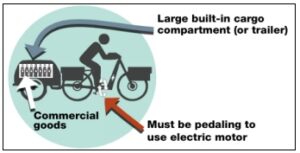 The Microhubs Pilot focuses on the transition of goods from trucks to sustainable last-mile modes, such as cargo bikes and hand carts. This team is testing on-street sites on the Upper West Side with goals of improving environmental sustainability, public safety, and operational efficiency for delivery workers. Phase 2 expansion is expected to launch this spring, Ponte said.
There are 800 electric pedal-assist bikes with cargo compartments which can help small businesses connect to clients or last-mile parcel delivery. “We see it as a tool to move cars and trucks off the road and improve air quality,” said Kerry Goleski, Sustainable Freight Lead, Blue Highways. Launched in 2019, it was successful enough to pursue as a permanent program in 2024 through regulatory changes to officially allow cargo bikes on New York City streets.
Future developments include creation of “Cargo Bike Corrals” dedicated to loading and unloading and publication of a comprehensive safety training guide for companies and cyclists. Next steps will include using origin and destination data and traffic counts to help DOT implement a network approach, Goleski said.
Blue Highways aims to help with mode shift by creating short-sea shipping routes in New York City Harbor, moving the middle freight mile from trucks to the water. The Blue Highways Action Plan published in October is a road map for how blue highways will be implemented:
- Define service lines (microfreight model)
- Identify sites
- Prioritize near-term activations
- Connections to landside infrastructure
LockerNYC
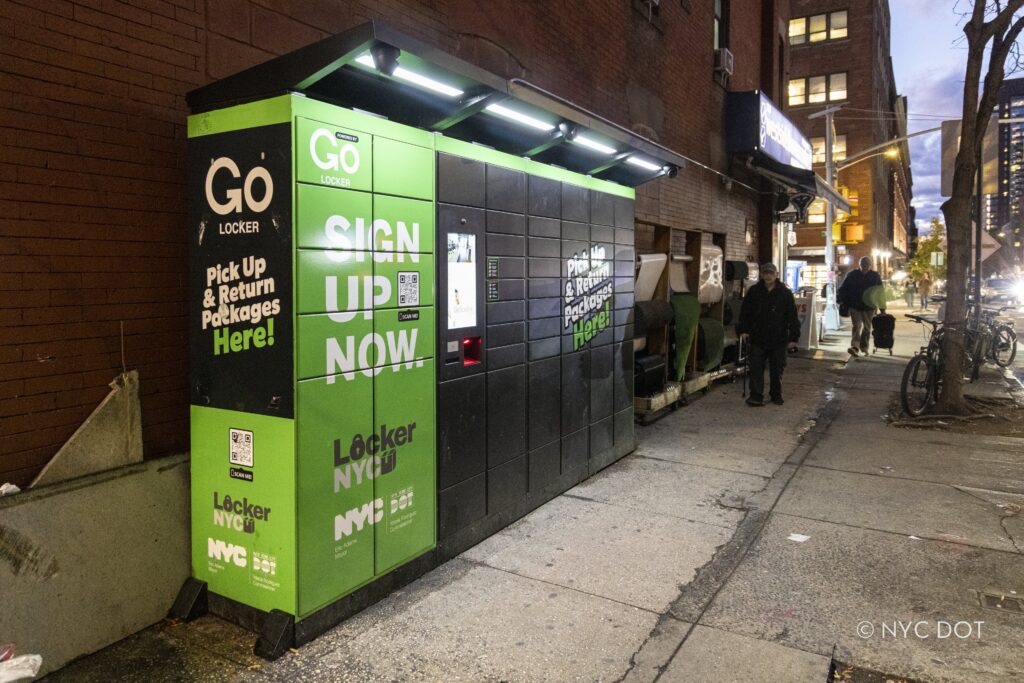
 The LockerNYC Pilot is a 24/7 shared-use delivery locker system designed to reduce truck trips and package theft. GoLocker, launched in April 2024, consolidates packages at a central warehouse before delivery to lockers. Quadient, a more recent vendor, allows multiple carriers to drop off packages directly into lockers.
About 75 lockers have been installed throughout the city. There are more than 2,800 registered users who have made more than 20,000 reservations while 348 inquiries were made for locker locations across 124 zip codes, according to Jack Holmes, Freight Planner for LockerNYC.
Neighborhood Loading Zones
Since becoming a permanent program, more than 950 Neighborhood Loading Zones (NLZs) have been installed citywide, leading to a 70-percent reduction in double-parking when properly implemented, according to a 2022 study. The goal is to ensure access along the curb for residential deliveries. Target areas could be those with denser land use since residential areas are likely to see more package activity.
Typical criteria include:
- Narrow streets with large residential buildings (typically more than 15 units)
- Existing bus stops or lanes or bike lanes
- Where double parking is common
- Loading zone length standard space to accommodate access for delivery vehicles
“We could carve out space on residential streets, particularly in more narrow, infrastructure-heavy areas with bike and bus lanes, to allow for trucks to pull in, use curb space and cut down on double parking in bike and bus lanes,” said Katrina Carey, Efficient Deliveries Lead, Off-Hour Deliveries and Neighborhood Loading Zones, for the Freight Mobility Unit.
Off-hour deliveries (OHD) began as a voluntary pilot program that included 25 receivers and eight transporters in Manhattan about 2010. Today, there are more than 1,110 active OHD locations with a goal to reach 5,000 locations by 2040. “The idea is to encourage businesses to switch from making deliveries at peak hours of the day, when traffic is heaviest, and move it to off-peak hours,” Carey said, adding that there’s been more interest since the inception of congestion pricing.
A recording of the FIC meeting and presentation will be available on the NJTPA’s YouTube channel.