


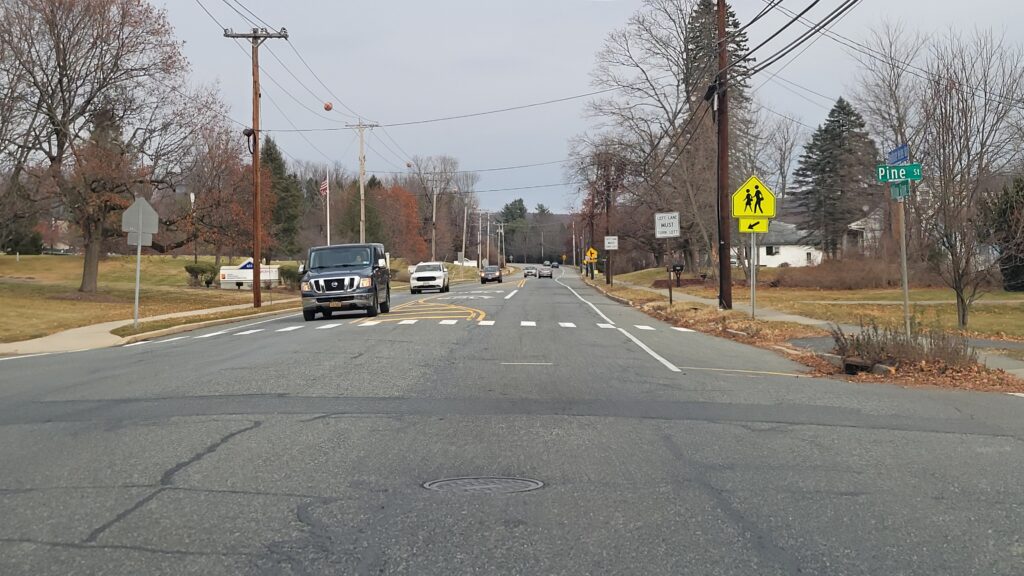
Rural and small-town strategies for designing safe streets that are comfortable, efficient, and accessible for all road users was the topic of a presentation to the Regional Transportation Advisory Committee (RTAC) at its December 8 meeting.
Ryan Conklin, Director of Planning, Warren County presented Connect Warren County. Completed and funded through the NJTPA’s Subregional Studies Program, the Warren County Complete Streets Implementation Plan aims to institutionalize the implementation of Complete Streets with a focus on rural and small-town strategies. Warren County has a population of almost 110,000, with many municipalities that are large in land area but low in population density.
The county is the midst of the implementation phase of the study, which it has been working on for about a year and a half, according to Conklin. Connect Warren County was developed simultaneously with the county’s Local Safety Action Plan to take a “a holistic approach to identifying and institutionalizing safety from a multi-use and multi-modal standpoint,” he said.
“We wanted this document to be more of a functional tool that can be used,” Conklin said, encouraging implementation of Complete Streets at the municipal level by providing resources to easily move forward on their own. The county Complete Streets policy is not a mandate but a guidance policy. The county will create a subcommittee of the Planning Board to monitor implementation of the overall plan.
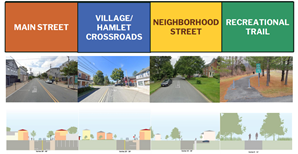
The study features a typology of eight different typical roads, from regional highway to neighborhood street, based on parameters like land uses, volumes and functional classifications. The typology includes contextual guidance, presenting recommendations on traffic safety, pedestrian mobility, bicyclist mobility, and green infrastructure features for each road type.
Hackettstown Case Study

Conklin presented an example of how the plan is already being put into action, with a proposed redesign of Willow Grove Street (CR 604) and Maple Avenue, a block from Route 46, which serves as main street in Hackettstown. Maple Avenue is a critical corridor that provides pedestrian access from downtown to a riverfront park. A triangle-shaped property inhibits functional crossing to the park, especially for pedestrians, Conklin said, in addition to an odd angled intersection that provides park access.

The proposed redesign, developed as part of this study, would realign the park entrance with Maple Avenue to provide safe vehicular and pedestrian park access and facilitate a key connection to downtown and the park, as well as the Musconetcong River. With the help of a grant from the New Jersey Department of Environmental Protection (DEP), the project also would address stormwater management issues near the site.
“You can really see the value of putting together a great planning document like this with input from the public and municipalities. Now we have potentially a shovel ready project that’s going to be designed and potentially constructed in the next year or two, where without this plan maybe this project never came to fruition.”
The key for this project and future implementation is to make sure to engage with stakeholders and other municipalities. “That was a really big part of the project. We invited the municipalities and talked through some of these conceptual designs and made sure commissioners were part of the group providing input,” Conklin said. He stressed tailoring the plan to individual needs of the community. “When we went through this planning process, we took a unique approach that was specific to our county and constituent and stakeholder needs. When you do that, you really garner buy-in and consensus and then the plan really becomes more implementable as a result.”
The presentation is available here and the complete, 125-page Connect Warren County plan can be found here.
A recording of the RTAC meeting can be accessed here.