


The most densely populated county in New Jersey has an ambitious plan to eliminate traffic fatalities by 2034.
Kevin Force, supervising planner, and Tanner Thull, senior transportation planner, presented an overview of adoption and implementation of the Hudson County Vision Zero Safety Action Plan at the Joint Project Prioritization (PPC) and Planning and Economic Development Committee (PEDC) meeting on Aug. 18.
County Executive Craig Guy created The Hudson County Vision Zero Task Force in August 2023 through an Executive Order. A U.S. Department of Transportation Safe Streets for All (SS4A) grant helped launch the planning process in 2024.
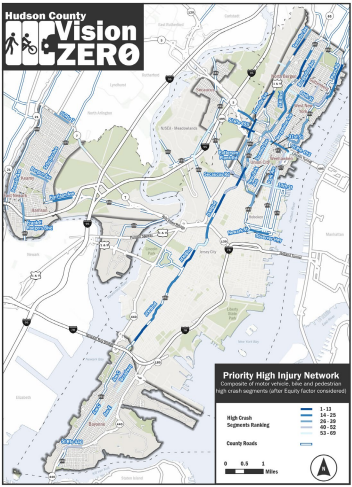
Almost every local road in Hudson County is included in the action plan. Hoboken, Jersey City, and roads in the Meadowlands District were excluded because they had separate Vision Zero initiatives underway. U.S. highways and interstates also are excluded except for Tonnelle Avenue since its street topography and interactions are unique compared to most state roads, Thull said.
The safety action plan “is the blueprint for how we are approaching Vision Zero moving forward,” Thull said.
All Vision Zero action items fall within four major themes:
- Change the culture of traffic safety through the Safe System Approach
- Design and build streets for everyone
- Partner and collaborate across different government agencies
- Enhance transit and active transportation
“It starts with public support,” Force said. “We have some very active traffic safety community groups that were seeing what was happening in other jurisdictions in our area, including Jersey City and Hoboken, and there was a lot of interest in expanding this effort to cover more areas and the whole county.” Discussions with community advocates and staff led to support by county commissioners and pursuit of the SS4A grant, and ultimately adoption of a Vision Zero goal and policy for Hudson County.
An education campaign built public support through tabling at farmers’ markets, concerts and community meetings. “We found that a lot of people were actually not familiar with the term, Vision Zero, even though it was starting to be adopted in our area,” Force said. “But when we explained what it was really about and what the purpose was, generally, it was something that people were in favor of. This just helps to build on the initiative.”
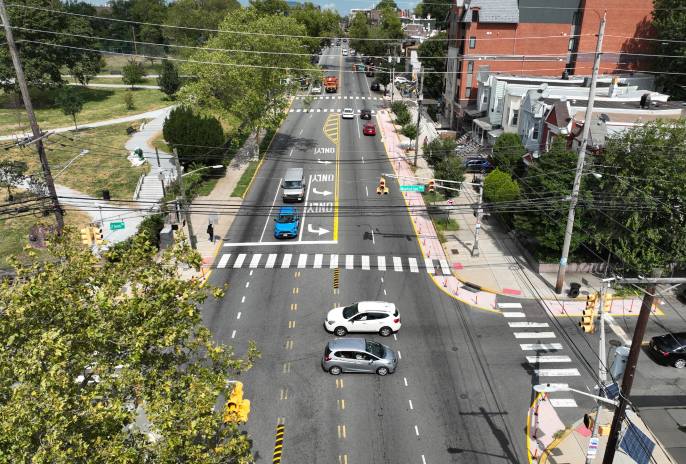
Pop-up events in every Hudson County municipality were highlighted by a temporary project in September along Kennedy Boulevard in Jersey City. The project employed the NJTPA’s Complete Streets Demonstration Library, installing safety counter measures for two weeks to collect public interaction and feedback.
“We were able to do outreach while we were setting up the project,” Force said, observing people in all modes of travel interacting with the project. “It was a very visual way to demonstrate the kinds of things we’re looking at with Vision Zero,” he said.
“One big part of our Vision Zero process, from beginning to today, is making sure our task force is engaged,” Thull said. It’s important to understand constraints as some municipalities have more resources than others. Having advocates in the meetings has been helpful, Thull said, specifically citing Hudson County Complete Streets and Safe StreetsJC.
The county is working with one municipality to do a walkability audit as one of the action items. Union City used the action plan for grant applications. “We want that to be a resource for them,” Thull said. “We’re looking to continue to collaborate and do joint applications with municipalities.”
A recording of the presentation can be found on the NJTPA YouTube channel.