


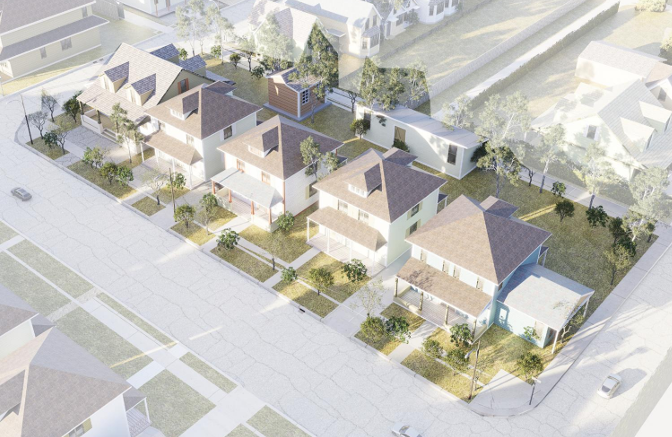
As communities across New Jersey grapple with housing affordability challenges, “missing middle housing” is emerging as a promising solution that can fit seamlessly into a wide range of neighborhoods, from urban centers and transit-oriented suburbs to small towns and rural communities. By introducing housing types such as duplexes, cottage courts, townhomes, and accessory dwelling units, missing middle housing offers a way to increase housing choice and affordability while preserving the character of existing neighborhoods.
At its June 8 meeting, the Regional Transportation Advisory Committee (RTAC) meeting heard from Anisha Selvam, who recently earned her Master of Science degree in architecture from NJIT and a certificate in urban ecologies and sustainable cities. She presented “Missing Middle Housing and the Use of Pattern Books: A Practical Visual Guide to Gentle Density.”
 Missing middle housing refers to housing that provides a variety of affordable options that are compatible with detached single-family homes, and can include multiunit structures, cluster homes and cottage courts. It’s intended to bridge the gap between single-family homes on one end of the spectrum and apartment buildings on the other.
“The NJTPA has long recognized housing and housing affordability as a critical issue that intersects with transportation and land use planning,” said Blythe Eaman, Director, Environmental & Sustainability Planning. The most recent Long Range Transportation Plan included consideration of state and local housing patterns in response to new federal requirements, she added.
“Pattern books can help municipalities visualize context-sensitive housing density and support local decision making in ways that are both practical and responsive to community character,” Eaman said. “This effort also reflects our broader commitment to providing meaningful technical assistance to communities throughout the region.”
What is a pattern book? Think of it as zoning but visual. Instead of pages of text, it shows developers and municipalities exactly what a building looks like before it’s approved. “The idea is satiety: Communities can see the outcome; developers know the rules, and you get some small-scale incremental infill instead of one giant project planning on a neighborhood,” Selvam said.
Selvam incorporated what works from 12 national pattern books, including Syracuse, New York, and Washington, D.C. Her toolkit identified six settlement types across New Jersey and later presented Missing Middle housing opportunities for each:
- 35 percent is automobile-oriented, like Parsippany and Wayne, with large lots up to 2 acres and cul-de-sacs.
- 22 percent, transit suburbs like Montclair and Westfield, with walkable downtowns and NJ TRANSIT access.
- 18 percent, inner ring suburbs, such as Belleville and Irvington, with strong transit, originally diverse fabric.
- 9 percent, historic boroughs, like Flemington and Red Bank, with dense walkable cores and strong historic character.
- 8 percent, urban core, like Newark and Paterson, featuring dense blocks, mixed uses, and transit.
- 8 percent, rural areas, such as the Monmouth exurbs and Warren County, with large parcels, scattered settlement, and no transit.
Each settlement type has distinct lot characteristics, infrastructure, and opportunities for missing middle housing, and the toolkit addresses all of them.

Standard urban lots of 40 to 55 feet wide, found in inner-ring suburbs like Belleville and Linden, are arguably the single highest opportunity lot in New Jersey for missing middle housing, according to Selvam. The width is ideal for a side-by-side duplex where both units get usable floor plans and exterior exposure.
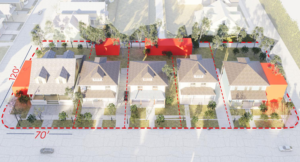
The standard suburban lot of 60 to 80 feet wide and 120 feet deep in places like Westfield, Rutherford, Cranford is the critical swing lot type. It can support Accessory Dwelling Units (ADU) and small duplexes. The rear yard, after setbacks, is usually 25 to 35 feet – enough for detached backyard cottages of 400 to 600 square feet. Additionally, an attached garage conversion to a one-bedroom ADU does not require board approval or a variance. “This is the most immediately deployable tool in the entire guide,” Selvam said.
The highest-yield redevelopment opportunity by total potential units is the commercial strip lot in the outer suburbs along Routes 1, 9, 22, and 46. Selvan gave the example of a single 2-acre Route 35 parcel currently 70 percent surface parking could accommodate 40 to 80 apartments, 10 to 18 townhouses, and 4,000 square feet of ground-floor retail with a structured parking deck.

Missing middle opportunities can even be found in the Garden State’s agricultural regions. New Jersey has about 730,000 acres of farmland, which is still roughly a third of the land area, primarily in the south and west. Additionally, the aging population and farmworker housing is a documented unmet need, Selvam said. A farm worker cottage or in-law ADU on an agricultural parcel and lot splits on parcels over 2 acres can provide cottage courts or small clusters. While it’s a lower yield per lot, it’s meaningful in rural communities with no other housing options, Selvam said.
This pattern book guide offers examples for developing a practically, legally grounded, visually clear roadmap for gentle density across every corner of New Jersey. Developing and adopting pattern books allows municipalities to streamline the permitting process, providing pre-approved design templates with clear compliance standards, which significantly cuts review timelines and makes smaller projects financially viable.
The presentation is available here and a recording of the presentation is available here.