


New supply of industrial space has leveled off, helping to stabilize rents, as third-party logistics (3PL) firms continue to absorb more of the market.
Thomas Tucci, Vice Chairman, Certified Supply Chain Professional, Cushman & Wakefield, and Walter Lane, Director, New Jersey State Office of Planning Advocacy, presented the Annual Industrial Real Estate Update during the February 17 meeting of the Freight Initiatives Committee.
Without Asian-supplied 3PLs, the market would be in a different place, according to Tucci. “They absorbed lots of demand that we didn’t have post-Covid,” he said. “If not for them, the market would be far worse.”
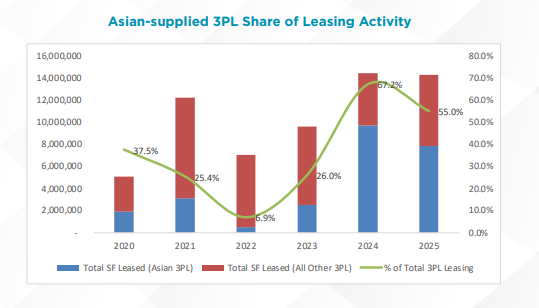 3PLs accounted for almost 40 percent of leasing activity in 2025 within Class A, newly built, state-of-the-art facilities. Cushman secured 88 leases across the U.S. last year, including 37 in New Jersey. “They’re not going anywhere. They’re going to continue to be a force to be reckoned with.”
One challenge for 3PLs is that their financial balance sheets are not strong so capital markets are having trouble underwriting their deals. “We haven’t yet seen it in New Jersey but there are rumblings that landlords are pushing away from these tenants, strictly because it becomes a capital problem,” Tucci said.
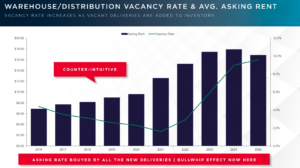
Vacancy peaked last year and Class A markets will be supply constrained by next year, according to Tucci. During Covid, vacancy rates increased not because of a lack of leasing activity but due to new development, with two of the highest years on record for Class A facilities. “Now that we’ve kind of flattened out our new supply…we’re starting to see now rents stabilizing and we’re getting to a more return to normalcy.”
There’s a consensus that 2026 will be a year that will return to normalcy as 2027 will see growth and the pendulum swing back toward landlords, Tucci said. “All this new demand being unmet into the market, with the supply in the state, will create a more landlord favorable market,” he said.
New Buildings, Modern Technology
 “Tenants want the newer, bigger, prettier buildings for better efficiencies” with modern technology that’s being rolled out for 3PLs, Tucci said, and that’s likely to continue, Tucci said. That will put a strain on ownership of Class B buildings, which might lead to longer vacancy times. Class B landlords will require significant capital for building improvements to create tenancy.
Redevelopment of Class B space, which are older second- or third-generation properties, might present opportunities not just for logistics but perhaps housing or advanced manufacturing and other redevelopment opportunities, Lane said. “The goal of the State Plan is to funnel that growth into areas that have existing infrastructure, build off the work of those previous public investments to get more bang in return for that investment,” he said. “Repurposing of those older, Class B office space and underutilized retail, that’s what the state is trying to do: Put all those underutilized assets to a better, higher productive use and doing that in support of compact, mixed-use development opportunities.”
 Rents essentially doubled from 2021 to 2024 so landlords are “stuck with high numbers in their minds,” Tucci said. Landlords are getting creative with deal terms and have been offering significant concessions, such as free rent, lower annual escalations, and tenant improvement dollars to entice higher rent and get buildings occupied.
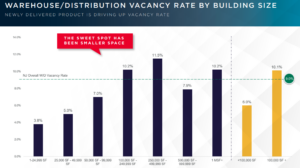
The sweet spot in warehouse and distribution has been smaller space, according to Tucci. Tenants looking for 150,000 to 200,000 square feet near the Port will have a host of options but those in search of 50,000 will have much fewer options. “That’s where size matters,” he said.
Guidelines to be Updated
Warehousing and goods movement guidelines developed by the state in 2022 will be updated in the coming year along with other guidance documents, Lane said. The guidelines help municipalities plan for these types of uses going forward and illustrate how to be proactive rather than reactive. “How do you balance all those competing needs and really encourage a regional approach to the planning and siting for these logistics facilities?”
In addition to outreach to industry partners, Lane said the effort will involve all three of the state’s Metropolitan Planning Organizations, all of which deal with freight and logistics issues. “This is a really good opportunity to partner and have some statewide guidance to be filtered in and integrated into regional planning efforts, then hopefully better integrated into local and county plans.”
A recording of the FIC meeting is available on the NJTPA YouTube channel.