


Automation, cutting costs, generating more revenue, and a longer-term vision for infrastructure will be critical to the reliability, safety, and security of public transportation in the coming years.
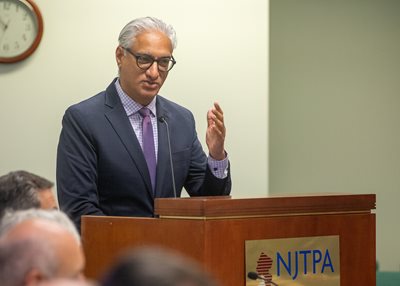
That was the message from NJ TRANSIT President and CEO Kris Kolluri to the NJTPA Board of Trustees at its November 10 meeting.
First, Kolluri congratulated the Board for adopting the latest Transportation Improvement Plan (TIP). “It’s a testament not only to you but to an adherence of this ongoing principle that these projects have come together not by accident but by design,” he said. “You work every single day to make sure that projects that will improve the lives of residents has been the cornerstone of this MPO [Metropolitan Planning Organization] and what is reflected in this TIP is just that.”
Part of the TIP is NJ TRANSIT’s almost $5 billion of capital projects, including about $1.74 billion in FY 2026. “When you put it all together, this is what a robust capital program looks like.”
The way Kolluri sees it, the three-legged stool of NJ TRANSIT, all underpinned by funding, includes infrastructure, rolling stock, and human capital.
Modernization
NJ TRANSIT has made a commitment to modernization, by replacing all rail cars with multilevels and all 2,400 buses by 2031 at a cost of almost $3 billion.
“There’s a very important reason: Reliability, safety, and security cannot be done because we hope it’s the right thing to do; we’ve got to act on it,” Kolluri said.
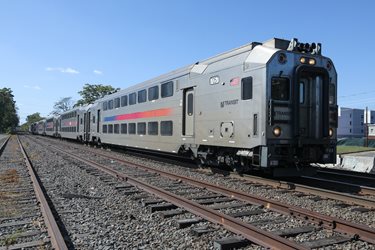
“You can’t rely on infrastructure that goes back 115 years and somehow say it’s going to work without any problems,” the former Gateway Development Commission CEO overseeing the Hudson Tunnel Project said. Not only is that project moving forward but other critical projects as well, such as the Portal North Bridge, which is almost 80 percent complete, and a new Raritan River Bridge along the North Jersey Coast rail line, he said.
Kolluri said that this country tends to focus on projects in the short-term, rather than taking a long-term approach like other countries.
“What my recommendation is, and it’s reflected in the TIP that you adopted: We need to be thinking about 50-, 60-, and 100-year terms. That is the right prescription to bring the state back to where we need to be.”
Human Capital
Even in a difficult job market, NJ TRANSIT can’t compete with the private sector, which creates a brain drain that the public sector must address, Kolluri said. “That’s something that will haunt us until there is a structural adjustment.”

He said the corporate transit tax has been critical because it provides predictable operational funding for the next five years. “You can’t do it if you have to look for money every year, here and there, under the seat cushions, hope and pray you run a system. That is not a way to run a modern organization.”
To generate revenue outside of fares and taxes, the agency last month unveiled The LAND Plan: Leveraging Assets for Non-farebox Dollars during an event at Metropark Station in the Iselin section of Woodbridge. Mixed-used developments are rising adjacent to the Middlesex County transit hub, which includes a stop on Amtrak’s Northeast Corridor line, and Hackensack Meridian Health plans to relocate its headquarters there.
Kolluri said the LAND Plan is expected to generate $1.9 billion over 30 years for the agency in addition to $14 billion for the state, and $3 billion to $4 billion for municipalities. “That is the path forward,” he added, but in partnership with counties and municipalities.
The agency is also cracking down on unpaid fares, which Kolluri estimates amounts to about $80 million in lost revenue annually. New fare gates have been piloted at Secaucus and Newark Airport stations, roving patrols have been added and the agency is exploring technology that can help “ensure people pay their fare before they get on,” he said, as is done every day on Long Island Rail Road.
‘Automation is Coming’

“Automation is coming whether you like it or not,” Kolluri said. “Within the next decade, the system as we know it will not look the same.”
Transforming the system will require protecting the people who have jobs and “real money,” he said. “The budget that was passed is a good foundation, but this is a wave that is coming, and our capital projects and our organizations need to be prepared to absorb. If we don’t, we’re already going to be a loser because we’ll be running an analog system in a digital world. That’s not a solution that is sustainable.”
A recording of the presentation is available on the NJTPA YouTube channel.