


A new interactive website animates the transportation needs and improvement strategies across the NJTPA region as part of the updated, federally mandated Congestion Management Process (CMP).
Eugene McGuinness, Principal Planner of Performance Analysis and Planning at the NJTPA, and Sunil Dhuri, Senior Director of Transportation, at ICF, presented an update on the CMP update, called the 2025 update of the Accessibility and Mobility Regional Reassessment (AMRR) during the October 14 meeting of the Regional Transportation Advisory Committee (RTAC).
The CMP analysis includes transportation needs and improvement strategies across the NJTPA region, identified through data assessment and stakeholder engagement in 2024 and 2025. The NJTPA is mandated by federal regulations to establish and periodically update the CMP for the region to systematically address congestion.
The CMP characterizes regional patterns of accessibility, mobility and congestion, noting needs and trends, and supports the Long Range Transportation Plan (LRTP) and future project development. The more recent Accessibility and Mobility Strategy Synthesis Study examined changes in travel patterns using the latest post-pandemic data, incorporating any new data sources that were unavailable in the last study done in 2021.
As part of this effort, 33 strategy profiles were updated to get them closer to implementation, adding information to guidance for best practices as well as potential funding sources.
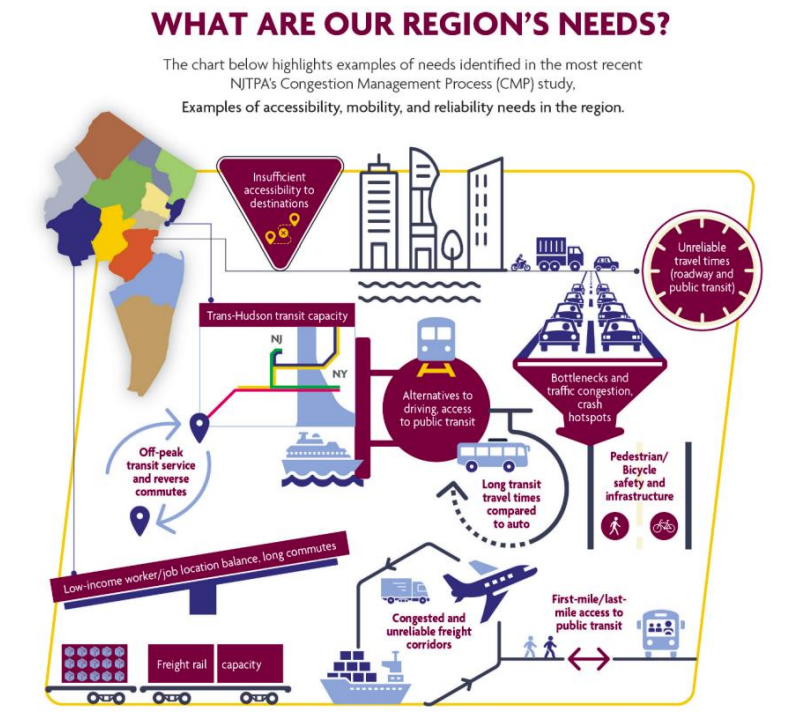
McGuinness said insufficient trans-Hudson transit capacity, promoting alternatives to driving in single-occupancy vehicles, and improving traffic bottlenecks, are among key issues that the study considered.
A series of technical reports identify locations of needs and strategy implementations The reports are animated within StoryMaps across nine sections:
- CMP Policy and Objectives
- Performance Measures and Needs
- Strategies
- Accessibility
- Public Transit
- Pedestrian, Bicycle, and Micromobility
- Roadway Operations and Capacity
- Freight
- Safety

This is not necessarily just recommending direct interventions and improvements but highlighting different accessibility landscapes to different modes of travel, McGuinness said. “There’s generally a great deal of maps that are very specific to the needs and strategies of the study.”
In a demonstration of the interactive website, McGuinness showed suitability analyses for some of the strategies that are applicable, one of which is to create transit supportive roadways that increase lanes available for transit vehicles. Analysis suggested some areas to pilot more transit supportive roadways, for instance in the Greater Newark area, including Bloomfield Avenue, Park Avenue, and South Orange Avenue.
Executive Director David Behrend described the CMP as “foundational” to the LRTP and encouraged people to explore all the information available.
A recording of the RTAC meeting is available here.