


Efforts toward reauthorization of surface transportation funding are ramping up with next year’s expiration of the Infrastructure Investment and Jobs Act (IIJA).

Bill Keyrouze, executive director of the Association of Metropolitan Planning Organizations (AMPO), outlined a potential timeline for Congressional action in remarks to the Metropolitan Area Planning (MAP) Forum on December 12. The NJTPA hosted the virtual annual meeting of the consortium of 10 Metropolitan Planning Organizations (MPOs) in the New York City region, stretching from Connecticut to Pennsylvania’s Lehigh Valley.
The current bill is set to expire September 30, 2026. The $1.2 trillion IIJA was signed into law on November 15, 2021, with $550 billion allocated for surface transportation. If no new reauthorization bill is passed by October, a Continuing Resolution by Congress will be needed to keep funds flowing.
IIJA significantly increased federal funding for transportation. It was an infrastructure package not just a surface transportation bill, Keyrouze said. Previous authorizations including the $305 billion in the FAST Act were incremental.
“Top of mind for everyone is how much the new reauthorization will be,” Keyrouze said, whether the total is a new standard or whether it will be walked back.
Until recently, the reauthorization was expected to be a flat bill not likely to reach $550 billion. There is ongoing discussion that the House bill could be $600 billion to $700 billion with the understanding that it may not be a straight surface transportation bill. “That’s great news for us but we’re tracking down details whether that’s real or not,” Keyrouze said.
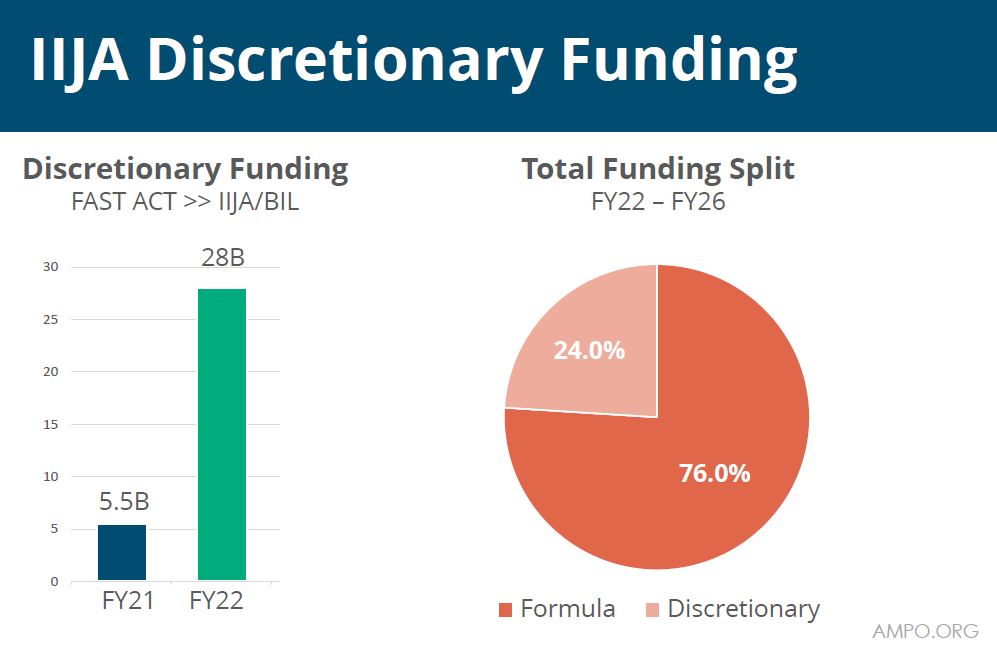
IIJA marked a shift to discretionary funding from formula funding. Under previous authorizations, grant programs were smaller. He noted that early signs indicate discretionary grants will revert to being more formula-based.
“A lot of those grant programs will likely fold into some formula program. Regardless of how funding was flowing, many of those programs opened eligibility to MPOs and local governments that historically did not exist,” he said.
AMPO supports retention of the 76/24 split of formula to discretionary funding. Previously the split was about 85 percent to states and 15 percent to regional and local government.
“We’re making the argument on the Hill that that split we’re seeing needs to stay about the same, that access to federal funds for regional and local governments needs to stay the same, whether through formula or otherwise,” Keyrouze said.
Authorizing committees are drafting language for the bill and Senate and House transportation committee leadership indicated they’re aiming for having a bill in the spring, Keyrouze said. “A lot of factors will play into whether this gets done on time,” he said, noting the slim majority in the House and midterm elections in the fall. There’s been emphasis on permitting reform to accelerate delivery and construction, he added.
House Transportation and Infrastructure Committee Chair Sam Graves of Missouri has said annual fees on electric vehicles may increase to fund the Highway Trust Fund, Keyrouze said, adding that Rep. Graves does not support a fee based on Vehicle Miles Traveled (VMT).
There’s “strong and significant interest” in local and regional decision making on both sides of the aisle, Keyrouze said. “We have not seen the base text but that’s certainly encouraging and exciting.”
A recording of the meeting and presentation can be accessed via the MAP Forum website.