


A review of some of Middlesex County’s most dangerous roads yielded a series of recommendations to improve traffic safety, including high-visibility crosswalks, a curbed median, Rectangular Rapid Flashing Beacons (RRFBs), and more.
The recommendations are the results of the Middlesex County Road Safety Audits (RSA), one of six active studies in the North Jersey Transportation Planning Authority (NJTPA) Subregional Studies Program (SSP) for Fiscal Year 2024-2025, which ended June 30. The SSP provides two-year grants on a competitive annual basis to open to the 13 North and Central New Jersey counties in the NJTPA region as well as Jersey City and Newark. It’s designed to assist the subregions in refining and developing transportation improvement strategies in the Long Range Transportation Plan.
Astha Negi, Senior Transportation Planner for Middlesex County and project manager for the subregional study, gave a brief presentation to the Regional Transportation Advisory Committee (RTAC) during its meeting on August 11.
The study advances the county’s Vision Zero Action Plan, which included RSAs of high-injury roads. In 2022, the County Board of Commissioners adopted the plan to eliminate fatal and serious injury crashes.
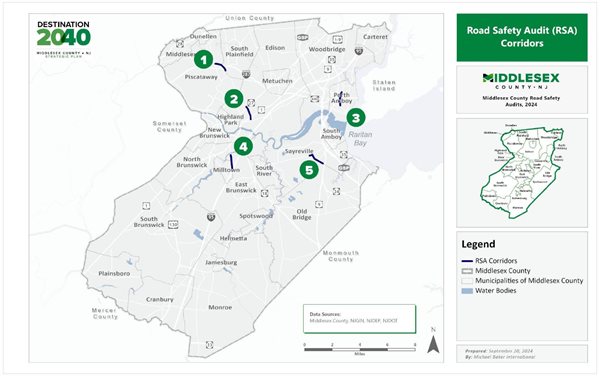
Middlesex County Road Safety Audits
Twenty corridors were whittled to a shortlist of 10 candidates, with five ultimately recommended for the study:
- Stelton Road (CR 529) in Piscataway and South Plainfield
- Plainfield Avenue (CR 529) in Edison
- Amboy Avenue (CR 653) in Perth Amboy
- Ryders Lane (CR 617) in Milltown and East Brunswick
- Ernston Road (CR 673) in Sayreville and Old Bridge
Locations were selected based on various criteria, including the High Injury Network (HIN) and seeking to address locations for all travelers, including bicyclists and pedestrians. RSAs uncovered safety concerns and proposed recommendations for improvements that will help fatal crashes and crashes involving injuries.
RSAs have been “one of our most effective project pipelines,” Negi said, to select high injury corridors for road safety improvements. As examples, she cited a road diet and redesign of Livingston Avenue and signalization and ADA improvements near the New Brunswick Train Station.
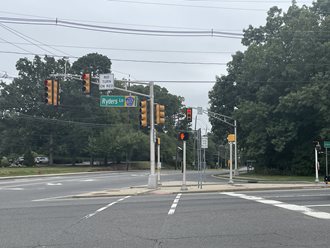
Negi reviewed the example of the Ryders Lane corridor. The audit team observed numerous residential driveways on high-speed corridors, few sidewalks, drainage issues, and poor sign visibility. Those observations were supplemented with videos of near-miss crashes particularly at Washington Avenue and Tices Lane, where there were many conflicts and near misses, according to crash data analysis.
Among the recommendations for the Ryders Lane corridor at Washington Avenue and Tices Lane were:
- Protected-only southbound left-turn
- Rectangular Rapid Flashing Beacons
- Retroreflective backplates and signal improvements
- Curb ramps and new sidewalk
- High-visibility crosswalks
- Curbed median
- Drainage improvements
Initial findings were presented to the public and stakeholders with feedback incorporated into findings that were presented publicly again, Negi said.
Now that the study is complete, the next steps include achieving both short- and long-term goals. “In the short term, we connected communities to resources like local advocates, elected officials, and police departments,” Negi said. “Sometimes being heard by the right people can make change happen and make it happen faster.”
Short-term goals also include local cross-collaboration with stakeholders and a pipeline to short-term projects. “Anything that’s just striping or cones, we want to address those more immediately,” Negi said.
Momentum built during the study paid off, Negi said, by advancing one of the corridors into a Safe Streets for All application. “What Middlesex County is trying to do is expand its network of safe infrastructure in the county, like safe sidewalks, safe crosswalks, safe intersections, and RSA is a foundation that starts the process.”
The Middlesex County RSA final report can be accessed here. The presentation and a recording of the RTAC meeting is available on the NJTPA YouTube channel.