


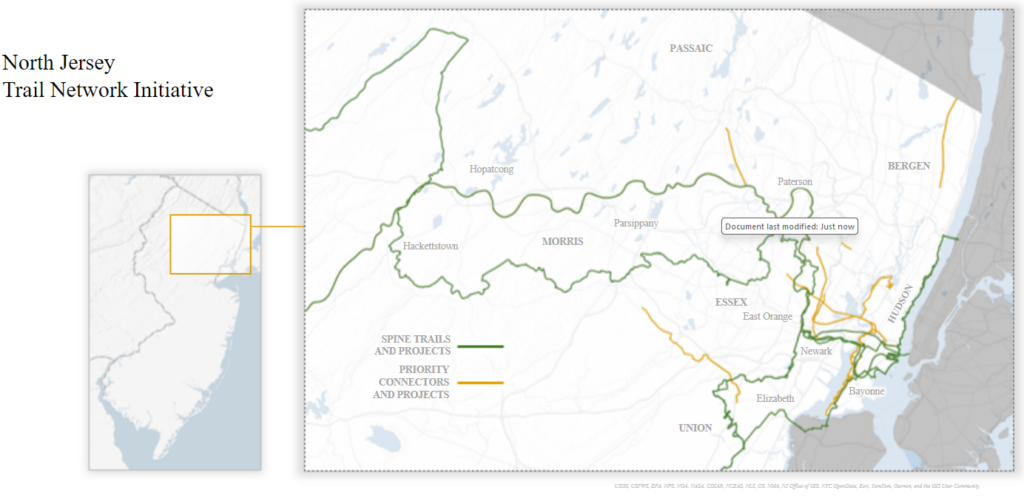
The North Jersey Trail Network Initiative, a partnership between the New Jersey Bike & Walk Coalition and the Rails to Trails Conservancy, would enlist stakeholders across the region to identify, prioritize, and eventually connect shared-used path trails into a network.
Debra Kagan, Executive Director of the New Jersey Bike & Walk Coalition, and Tom Sexton, Northeast Regional Director of the Rails to Trails Conservancy, presented the fledgling concept to members of the NJTPA’s Regional Transportation Advisory Committee (RTAC) at its October 15 meeting.Development of a network of shared use paths in North Jersey is “an essential part of creating active transportation options and to increase access for recreation,” Kagan said. “The idea of a regionwide (trail) network is something we’ve been working on for a while,” she said. The Greenway, formerly the Essex-Hudson Greenway from Jersey City to Montclair, was purchased by the state in 2022, and aims to have two sections open to the public by the end of next year.
A network map will prioritize corridors, build support across the region and establish an advisory group to identify priority projects and help with implementation and funding. The initiative would connect existing long-range trails, such as the NJTPA-led Morris Canal Greenway, Sept. 11 National Memorial Trail, East Coast Greenway, and others. “We’re also looking to identify new potential trails, whether they are abandoned rail lines, utility lines, or concepts that have been around a while but not been able to be developed,” Kagan said.
The initiative will focus on the six northeast subregions in New Jersey: the counties of Bergen, Essex, Hudson, Morris, Passaic, Union, and the cities of Jersey City and Newark. “That’s really a question of resources at the moment. We’re going to focus on the northeast section. It’s the densest and heavily in need of support to identify these corridors,” Kagan said. “This is just a focus for now, we certainly look and expect to develop the network across the whole region,” she added.
“Many of you know what happens when trails are created,” said Sexton, who oversees technical assistance and policy in 10 Northeastern states. “It helps the economy, gives us transportation choices, it’s better for the environment, better for our health. But to really amplify this, we need to build networks.”
States are also creating regional visions, Sexton said, pointing to a 1,100-mile trail in New England that’s halfway done after four years that will unite Connecticut, Massachusetts, New Hampshire and Vermont. The most successful states have identified priority segments and a vision that’s made clear so funders know where to put their money, he said.
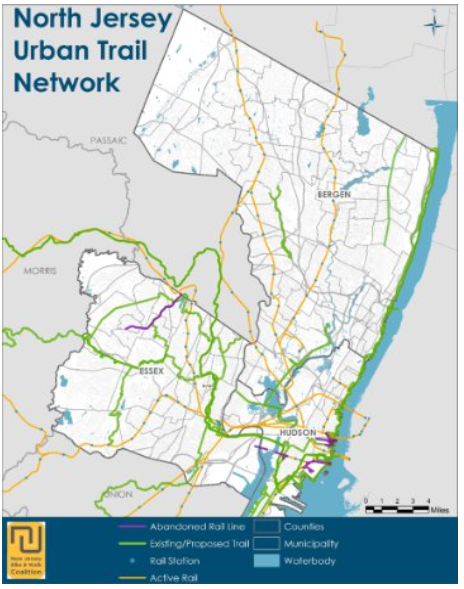
“We know that we’re going to need you to participate,” Kagan told RTAC members. “This is the very beginning of this initiative so we’re coming to you as early as possible to incorporate all the input from counties but also bringing you to together to look at this as a regional project, and regional connections where may not be specifics for each county but priority corridors go across counties. That’s why this initiative, we’re looking to develop some structure to build those initiatives.”
A working group with representation from different subregions, other major trails, and stakeholders could meet as early as December, according to Kagan. “We will be in touch with the planning departments from counties and subregions to ask you if you’d like to participate in a working group.”