

“Why do so many communities struggle to move from safety plans to built projects? Are we failing at safety or are we asking local governments to simply do the impossible?”
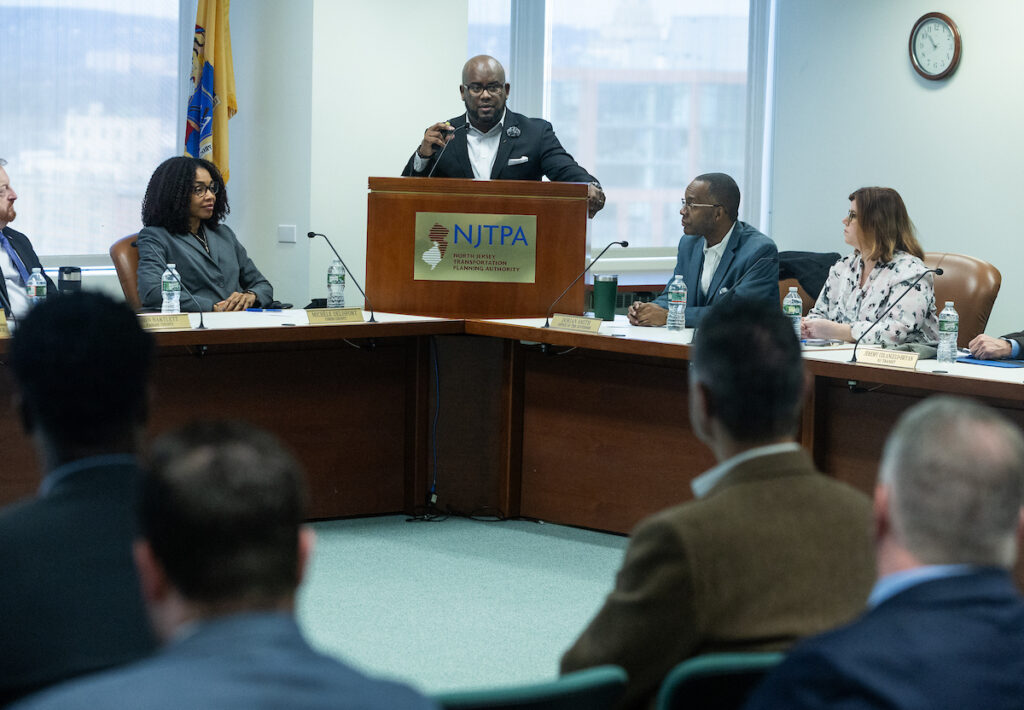
Charles T. Brown, president and CEO of Franklin-based consulting firm Horizon 54, formerly Equitable Cities, raised those questions and sought to answer them during a presentation, “From Idea to Implementation: National Tools Helping Local Governments Deliver Safer Projects,” at the NJTPA Board of Trustees meeting on January 12.
Plans are adopted, funding opportunities identified and yet projects stall, Brown said. “We often talk about this among ourselves as a sort of a technical problem, or design problem or better yet a problem with public or stakeholder engagement. But if that was the whole story, we wouldn’t see the same pattern happening, not just here in the state, but all over the country,” he said.
At the local level, it isn’t a matter of commitment but a system that’s designed to not function at the highest level, he said. “On the ground, what you don’t see is indifference,” he said. “If we know what saves lives, why is that local government still struggles?” This is a New Jersey problem but not a New Jersey failure, according to Brown. “The challenges that we’re solving nationwide are same challenges that New Jersey communities are facing,” including safety, staffing, coordination, and project development. “This isn’t about being behind, it’s about operating in a system that makes delivery harder than it needs to be,” he said. “We’re aware of the rising safety risk, staffing shortages and burnout, and also the lack of coordination in some cases across agencies. What this ultimately does then is make project development uncertain.”
Brown delved into three federal programs that are not standalone programs, he said, but designed to work together in an ecosystem to solve these problems:
- Thriving Communities Technical Assistance (TCTA)
- Reconnecting Communities Institute (RCI)
- Thriving Communities Program
There is a lack of staff capacity, technical expertise, and thus, lack of overall confidence to get it done for people they serve, according to Brown. These programs provide grant readiness and project scoping, leadership, and capacity building. It addresses the issue of lack of staff, not knowing where to start, or missing another cycle.

RCI supports communities working to repair harm that infrastructure has caused. “It’s about building alignment before projects stall,” Brown said. Past infrastructure decisions have left too many communities divided, unsafe, or disconnected, he added, not only for Black and Brown communities but also low-income communities.
Coordination between the U.S. Department of Transportation and Housing and Urban Development is where these programs come together. In one example, the I-81 Viaduct project in Syracuse, New York, a public housing complex is being demolished and will be rebuilt with mixed use and affordable housing. “Ultimately, it gives residents confidence they won’t be displaced,” Brown said, adding that Syracuse is an example as a way to infuse community engagement in the process.
The program is not just about rebuilding infrastructure but about rebuilding trust with the community and having shared purpose, according to Brown.
The Thriving Communities program is about moving from vision to fundable projects, providing hands-on technical assistance to help underserved communities plan, scope, and advance transportation projects that ultimately improve safety, access, and economic opportunities.
“This matters here because if you speak to municipal representatives, what you’re going to hear is that there is a lack of staff capacity to move projects forward, there’s a lack of technical expertise. What happens as a result, there’s a lack of overall confidence to get it done for the people they serve,” Brown said. Technical assistance programs like NJTPA’s Complete Streets Technical Assistance and Vibrant Places are great things at the local level and prepare you for federal funding, he added.
“We don’t need more ambition, what we need is less friction. Take advantage of the federal programs that are here,” Brown told commissioners.
A copy of the presentation can be found here and a recording of the January meeting is available on NJTPA’s YouTube channel.