

This page is intended for NJTPA subregions interested in applying for funding through the Subregional Safety Improvement Program (formerly Local Safety Program). For general information about this program visit the Subregional Safety Improvements and High Risk Rural Roads page.
The Highway Safety Improvement Program (HSIP) is a core Federal-aid program with the purpose of achieving a significant reduction in fatalities and serious injuries on all public roads, including non-State-owned public roads. Highway Safety Improvement projects must be consistent with the State’s Strategic Highway Safety Plan (SHSP) and are selected on the basis of supportive crash data.
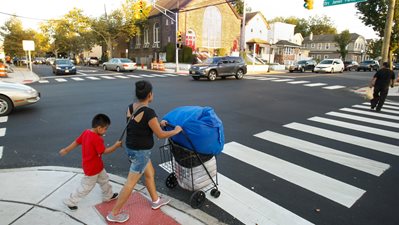
In January 2012, FHWA issued a “Guidance Memorandum on Promoting the implementation of Proven Safety Countermeasures.” This guidance takes into consideration the latest safety research to advance a group of countermeasures that have shown great effectiveness in improving safety. In 2021, FHWA updated the list which now includes 28 Proven Safety Countermeasures. Consideration of FHWA proven safety countermeasures is an important component in this program.
A solicitation for the Subreigonal Safety Improvement Program occurs on nearly an annual basis. Program details include:
- Projects must either be identified on high crash network screening lists prepared by the NJDOT or propose eligible systemic safety improvements;
- Only NJTPA member subregions are eligible to submit applications to the NJTPA for this program (the 13 member counties and the cities of Newark and Jersey City). Municipalities located within the subregions may make a request through their respective county to sponsor an application. The project sponsors are the designated responsible charge for overseeing and adhering to the federal funding process;
- Subregions are limited to two (2) applications;
- Improvements NOT eligible under this program: Routine maintenance/ replacement projects (including general resurfacing projects), congestion management/roadway capacity enhancements (road widening), improvements involving State, U.S. and Interstate highways including any improvements at intersections with such facilities and aesthetic improvements along the right-of-ways;
- Project sponsors must complete Highway Safety Manual (HSM) and benefit/cost analyses as part of the application process;
- Consideration to modern roundabouts for all new intersection and intersection upgrade projects (see the application for more details);
- The federal National Environmental Policy Act (NEPA) regulations must be followed. As such, projects must have minimal or no environmental and cultural resource impacts and be eligible for a NEPA categorical exclusion (CE) document approval.
NJTPA supports the Subregions with traffic counts, crash analysis, signal warrant analysis, lighting analysis, conceptual layouts and HSM/Benefit Cost analysis through the Consultant Assistance with Subregional Safety Programs Studies/Analyses.
Projects that have been selected to advance in the program can be further assisted through the Subregional Engineering Assistance Program (SEAP). The SEAP provides Subregions with design assistance in the preparation of plans, specifications, permitting and cost estimates needed for construction authorization.
Examples of SSIP Implementation
The City of Newark was designated by the FHWA as a pedestrian focus city. The NJTPA has been working with the City on numerous safety projects at intersections and along corridors to improve pedestrian safety. View the visual rendering of the LSP project on Broad Street.
A road diet is a Proven Safety Countermeasure that has been shown to reduce fatal and serious injury crashes between 19 and 47 percent. It provides better mobility and access for all road users, while calming traffic and enhancing overall quality of life. View the visual rendering of a road diet project in Manville, Somerset County.

FY 2026 Subregional Safety Improvement Program Projects
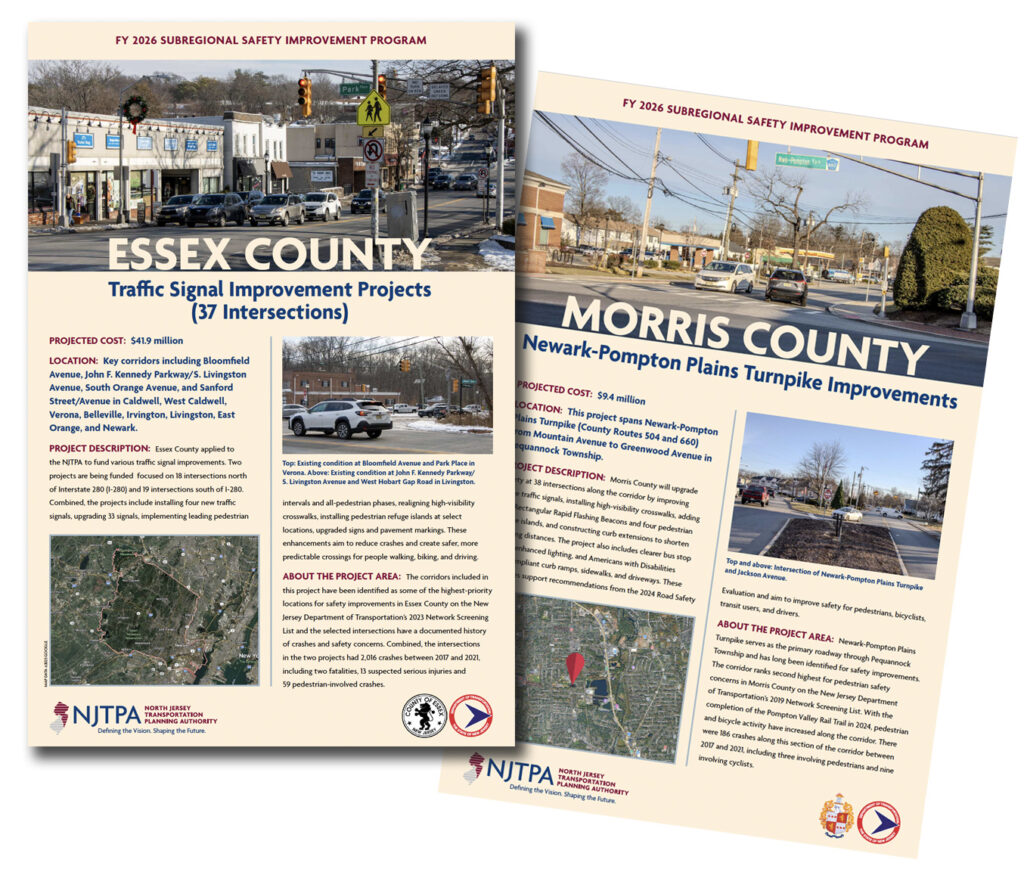
The NJTPA Board of Trustees in January approved eight projects totaling $147.7 million that will improve safety for motorists, pedestrians, bicyclists, and transit users throughout the region. The projects were approved for grants through the Fiscal Year 2026 Subregional Safety Improvement Program, which provides federal funding to counties and cities for targeted, cost-effective safety improvements.
The projects being funded include:
- Clinton Avenue Projects–Sections I and II (City of Newark) – $39.3 million
- Broadway Signal Improvements (City of Bayonne, Hudson County) – $15.7 million
- Cedar Bridge Avenue Improvements (Lakewood Township, Ocean County) – $12.0 million
- Newark–Pompton Plains Turnpike Improvements (Pequannock Township, Morris County) – $9.4 million
- Somerset Street and Old York Road Pedestrian Safety Improvements (Raritan Borough, Somerset County) – $8.2 million
- Traffic Signal Improvements (7 intersections) (Union County) – $11.1 million
- Traffic Signal Improvement Projects (37 intersections) (Essex County) – $41.9 million
- Jackson Mills Road and Sweetmans Lane Projects (Monmouth County) – $10.1 million