


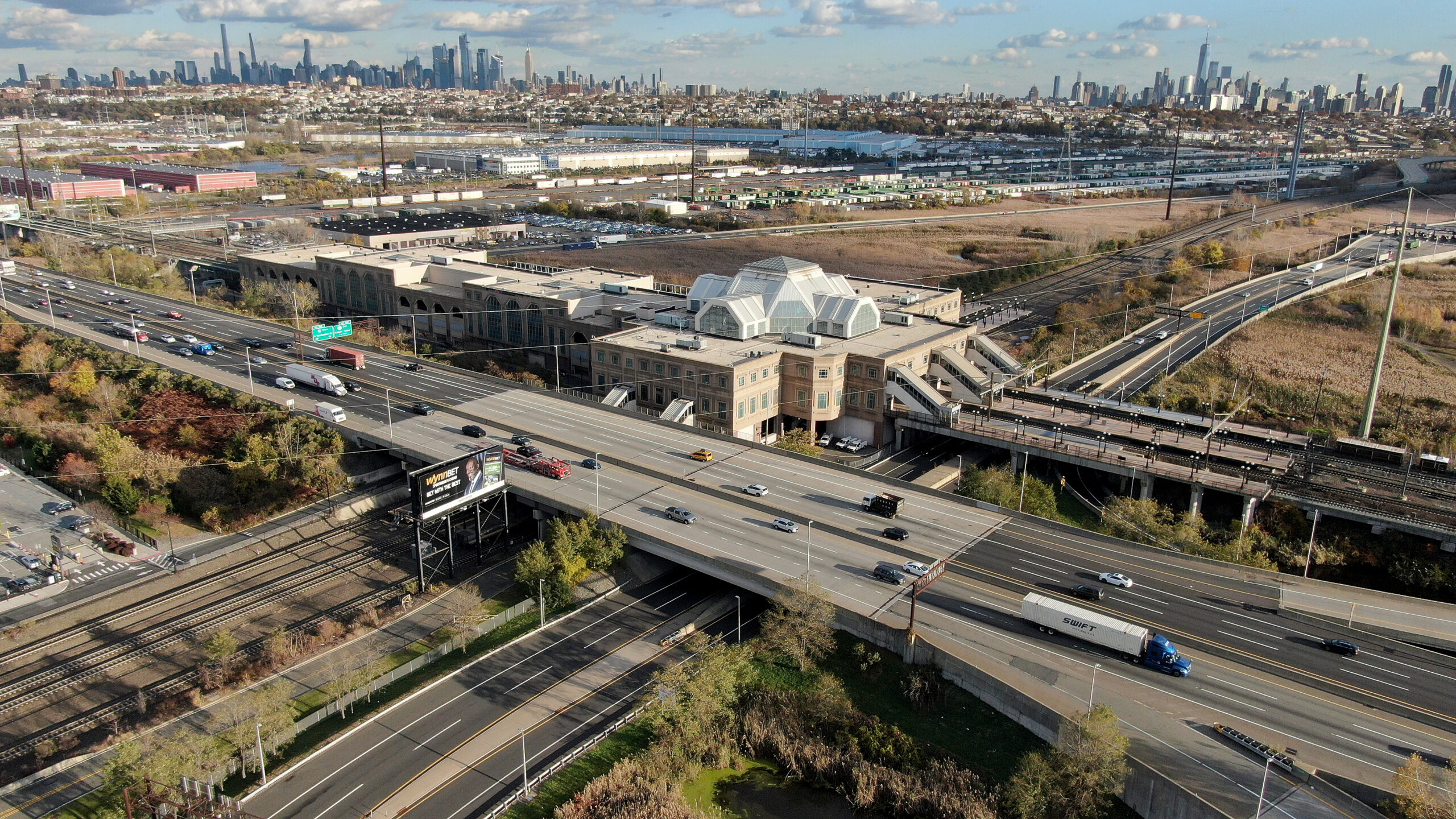
Secaucus Junction NJ TRANSIT rail station shown alongside the New Jersey Turnpike.

The North Jersey Regional Transportation Model‑Enhanced (NJRTM‑E) is an essential tool used in the NJTPA metropolitan planning process. This travel demand model fully incorporates the multimodal nature of transportation issues facing the region so that it can be used by all major transportation agencies. It is used for Air Quality Conformity Determination analyses and a host of long-range planning and project development studies, including the most recent Long Range Transportation Plan update in 2025.

The NJRTM‑E has been maintained and updated in partnership with NJDOT and NJ TRANSIT since its original development in 1986, with a major upgrade completed in 2008. It has been revalidated several times, most recently in 2023, when the model was migrated to Cube 2023 (Open Paths). These efforts have also improved the transit reporting capabilities and estimation of external trips entering the NJTPA region. 

The latest model was revalidated using 2020 Census data and 2019 base year traffic conditions. The model also was updated to include the congestion pricing program, which began in early 2025 for trips entering lower Manhattan. The data and documentation for these most recent official model executions are available on the sidebar. More specifics on the characteristics of the NJRTM-E (including platform, zonal system, networks, purposes, modes, etc.) are available below.

The NJRTM‑E is available on request to consultants and transportation professionals.

  • Platform: A standard four-step model, the NJRTM‑E runs on Bentley CUBE (as an interface), and Voyager with additional applications used for reporting.
  • Zonal System: There are 3,028 traffic analysis zones (over 1,700 of these are in the NJTPA region). The model includes all of New York City and Long Island, portions of southern New Jersey, portions of southern New York State, southwestern Connecticut, and portions of eastern Pennsylvania.
  • Highway Network: Within the NJTPA region, the highway network includes most arterials (major and minor) with most 500 level and 600 level county roads. Most collector or local roads are not included. Outside the NJTPA region, the highway network is more schematic, generally representing major regional roadways.
  • Purposes: The model covers eight trip purposes:
    • Home-Based Work Direct (trips between home and work with no intermediate stops)
    • Home-Based Work Strategic (trips between home and work with one or more intermediate stops)
    • Home Based Shopping (trips between home and shopping destinations)
    • Home Based Other (all other trips that either begin or end at home)
    • Work Based Other (trips based at work, other than those associated with the trip from or to home)
    • Non-Home-Non-Work (all other trips that have neither origins nor destinations at home or work)
    • Airport Trips (trips to or from Newark airport)
    • University Trips (trips to or from regional colleges and universities made by students)
  • Modes: Six travel modes are considered for most trip purposes (seven for the Home-Based Work trip purposes):
    • Single-Occupant Vehicle (SOV)
    • 2-Occupant Vehicle (HOV-2)
    • 3-Occupant Vehicle (HOV-3)
    • 4 or More-Occupant Vehicle (HOV-4+)—only for Home-Based Work purposes
    • Public Transit-Walk Access
    • Public Transit-Drive Access
    • Trucks (not specified by trip purpose)
  • Public Transit Network: The transit network includes NJ TRANSIT rail and bus networks, some private bus lines, and ferry services.
  • Trip Generation: The model considers population, household (differentiated by the presence of children and/or retirees) and income data.
  • Highway Assignment: There are four separate networks for the time periods in the model (including expanded peak hour periods):

For further information, contact Hella Alnajjar at (973) 877-8124 or halnajjar@njtpa.org