


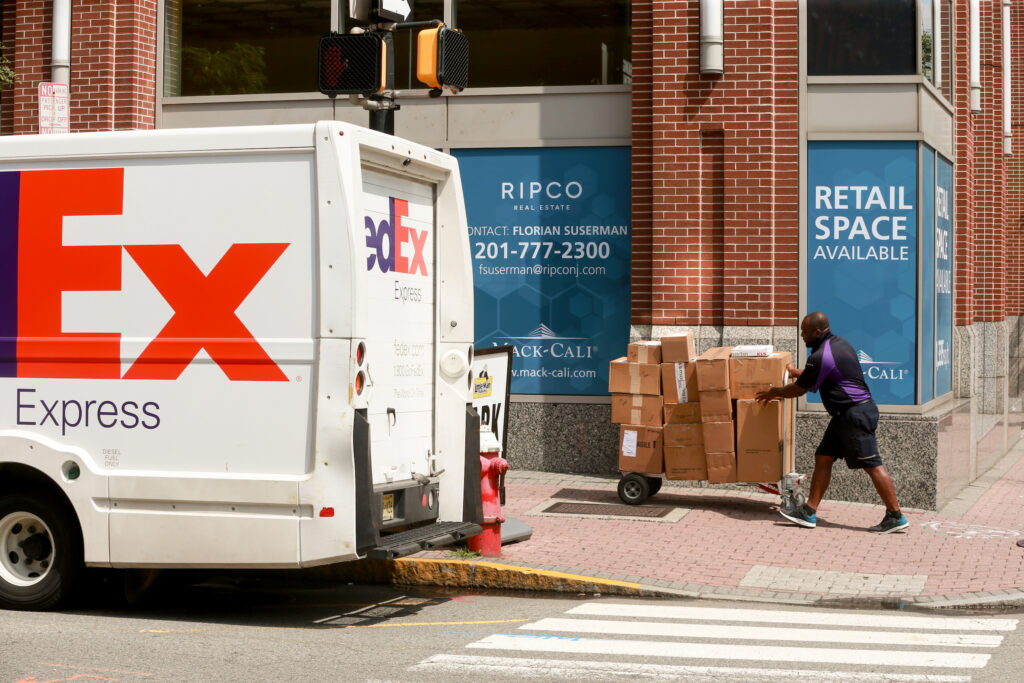
In urban areas, curb space is one of the most sought-after spaces, with cities trying to balance the need for parking with deliveries, public transportation and other uses.
“It’s one of the most contested pieces of infrastructure in today’s cities,” said Michael Willson, a transportation planner at Arup. “We’re seeing increasing demand for both long-established uses – whether it’s parking, transit, etc. – but also quite significant increase in demand from emerging uses.”
Those emerging uses include freight and on-demand deliveries, such as takeout and groceries, outdoor dining and public space, micromobility and electric vehicle charging.
Willson was among three speakers who presented on Urban Delivery Management at the October Freight Initiatives Committee Meeting.
Arup engaged public and private sector leaders in freight, electric and autonomous vehicles, transportation safety and from Uber to understand their curb space needs and published Urban Curb Management Strategies: The State of the Practice Post-Pandemic. The report provides best practices, innovations and recommendations.
Willson said one of the key findings is maximizing productivity at the curb, which means different things for different cities. He said curb space should be repurposed for the most productive uses based on established priorities and goals for the area and curb demand and delivery vehicle forecasting should be integrated into the planning review process.
He highlighted a New York City pilot where loading zones were expanded, resulting in a 73-percent reduction in double parking, which reduced collisions and improved bus speeds.
The report also suggests shifting curb demand to off-street infrastructure or underutilized curb space where possible and retrofitting existing facilities to provide sufficient space to manage deliveries.
Logistics Planning in Paris
Like many U.S. cities, Paris, a major logistics hub with more than one million goods moving through it each week, also grapples with demands on its curb space and roads.
Reece Fisher, a Ph.D. student studying logistics at the Université Gustave Eiffel, presented on regional planning work that proposes a network of facilities at different scales that moves goods closer to consumers, to better facilitate last-mile deliveries. She said this goal is driven by the growth in e-commerce and the demand for quicker delivery times.
Fisher said the city has encouraged the developers to repurpose underutilized sites into mixed-use logistics hubs. Examples include the Montmartre Urban Distribution Center, which replaced an abandoned auction house. The lower level is used for logistics while the upper levels contain housing.
Similarly, the Chapelle Internationale Logistics Hotel replaced a former train storage facility. It has an intermodal rail terminal, logistics uses, a store similar to Costco in the U.S., a gym, sports facilities, a data center and an urban farm all in a 41,000-square-foot building.
Piloting Micro Freight in Washington, D.C.
The District of Columbia is using federal funds to explore Amazon’s use of cargo e-quads – four-wheeled e-bikes that hold up to 650 pounds of cargo – in bike lanes and bus lanes.
Laurina Bird, a transportation planner in the District Department of Transportation (DDOT) Curbside Management Division, said the 10-month pilot is for the Capitol Hill and Navy Yard neighborhoods, very dense residential and commercial areas. The study is part of a larger effort to collect data on e-cargo bike operations and evaluate the benefits of sustainable delivery modes.
Setting up the pilot required a lot of coordination with zoning and enforcement agencies, Bird said. DDOT also had to identify a surface parking lot to create the microhub, which is used to transfer packages from trucks to e-bikes and store and charge the bikes. The pilot launched in May, and e-bikes are being used to carry about 300 pounds of packages per run, with two runs per day on the routes. The bikes have a maximum speed of 15 mph and are prohibited from using sidewalks.
One issue in the pilot has been delivery bikes blocking bike lanes, which is not allowed under the permit Amazon has to operate the pilot. Another is that bike lanes are too narrow for the delivery vehicles in some places, in which case the vehicles move to travel lanes. One positive is no reported crashes so far, Bird said.
All the bikes feature QR codes on them that the public can scan to report issues or provide feedback. There is also a website and community survey to gather input on the pilot.
So far, the 14 cargo e-bikes have been delivering almost 100,000 packages per month.
“We feel confident, that given enough time, this model will reduce truck miles and associated CO2 emissions,” she said.
A recording of the presentation is available on the NJTPA YouTube channel.