

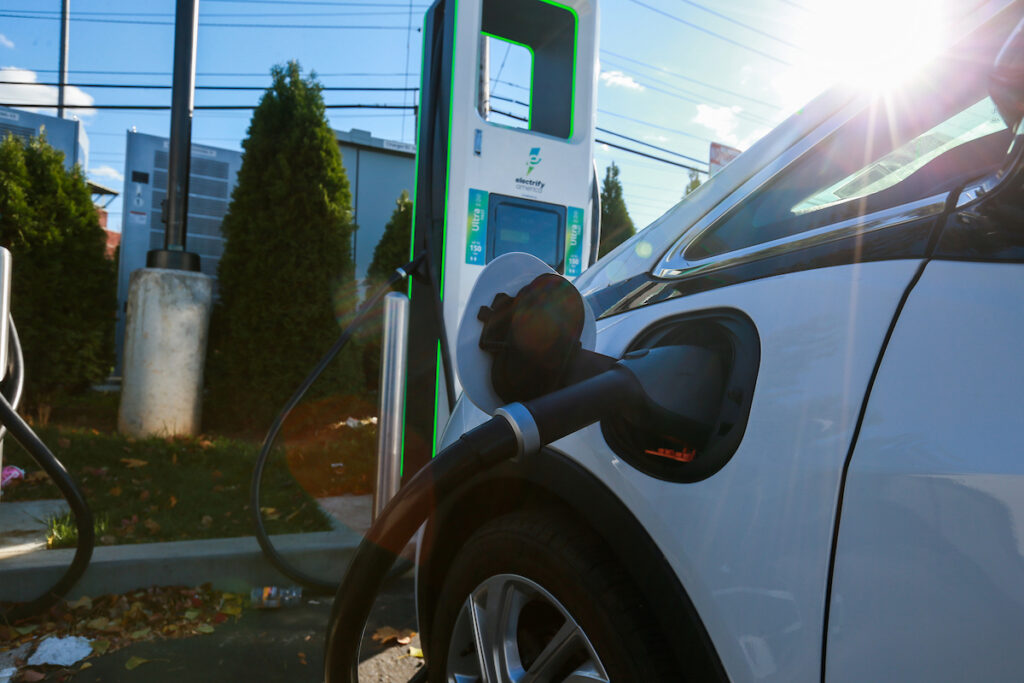
Electric vehicle (EV) adoption has grown significantly across New Jersey over the past five years, though the latest registration data shows momentum slowing.
NJTPA Principal Planner Zenon Tech-Czarny shared the latest state data covering January through June 2026 and highlighted trends in EV adoption and charging infrastructure across the NJTPA region during a presentation to the Regional Transportation Advisory Committee on October 13.
New Jersey now has just over 280,000 EVs on the road, including more than 218,000 in the 13-county NJTPA region. As of June, 78 percent of the state’s EVs were battery electric vehicles (BEVs), and 21 percent were plug-in hybrids (PHEVs).
EV adoption grew strongly over much of the past five years, supported by state and federal policies and incentives, including New Jersey’s EV sales tax exemption, the state’s Charge Up New Jersey program, and the federal Clean Vehicle Credit.
However, the policy and incentive landscape have changed. Several factors contributed to slower growth, including the introduction of New Jersey’s EV user fee, changes to the Charge Up program, the end of the state sales tax exemption, and the expiration of the federal tax credit.
Between January and June 2026, about 5,500 new EVs were registered in the NJTPA region, an increase of 2.59 percent from the previous reporting period. It was the smallest numerical increase since December 2020 and the smallest percentage increase since NJTPA began tracking the data.
The slowdown comes as overall vehicle sales have also declined. Tech-Czarny noted that total light-duty vehicle registrations in New Jersey were down 9.5 percent compared with the same period a year earlier, while BEV registrations were down 45 percent.
The trend has important implications for the state’s climate goals. Transportation accounts for 37 percent of New Jersey’s greenhouse gas emissions, making the transition to electric vehicles an important component of efforts to reduce emissions.
Growing EV Adoption Requires More Charging Stations
 Access to public charging infrastructure remains another key challenge for EV adoption.
NJTPA analyzed U.S. Department of Energy Alternative Fuels Data Center data to identify charging locations that are clearly available to the public, rather than locations restricted to residents, employees or paying guests.
The analysis found 1,447 public Level 2 charging ports and 1,247 DC fast-charging ports in the NJTPA region.
While the number of public charging ports has grown, Level 2 infrastructure has not kept pace with demand. Based on modeling using the U.S. Department of Energy’s EV Pro-Lite tool, the state should have approximately one public Level 2 port for every 26 EVs. In the NJTPA region, there are currently about 151 EVs for every public Level 2 charging port. The analysis estimates that the region would need approximately 6,903 additional public Level 2 ports to meet current demand.
The shortage, along with limited access to charging at many multi-family developments, could be another factor affecting EV adoption.
Although the region has more DC fast-charging ports relative to modeled demand, their location is just as important. Strategically, placing fast chargers can help ensure they are available where they are needed most.
How Communities Can Support the EV Transition
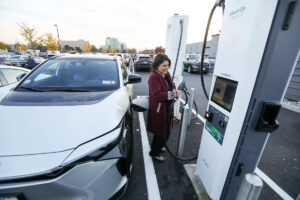
Counties and municipalities have several ways to help expand charging infrastructure and support EV adoption.
Communities can develop EV readiness and community energy plans, incorporate EV considerations into master and transportation plans, adopt the statewide EV charging ordinance into local codes, and establish policies supporting EV adoption. Tech-Czarny highlighted EV readiness planning already undertaken in Middlesex, Somerset and Hudson counties as examples.
Local governments can also install charging infrastructure directly or pursue public-private partnerships, provide EV education and outreach to residents and businesses, train first responders and other government employees on EV technology, and begin transitioning their own fleets.
The NJTPA and its partners offer resources to help communities with these efforts. Transportation Management Associations can assist with EV education, outreach and strategy, while the NJTPA’s Subregional Studies Program can support EV readiness planning. Funding is also available through the NJTPA Subregional EV Charging Infrastructure Program.
More information and guidance for communities interested in supporting EV adoption and expanding charging infrastructure is available through the NJTPA EV Resources Hub.