


Electric vehicle (EV) registrations in New Jersey continued to grow in the first half of this year, on par with the same period in 2024 but short of the state’s overall goal.
Zenon Tech-Czarny, Principal Planner, Environmental Planning at the NJTPA, provided the biannual regional EV registration update during the October 14 meeting of the Regional Transportation Advisory Committee (RTAC).
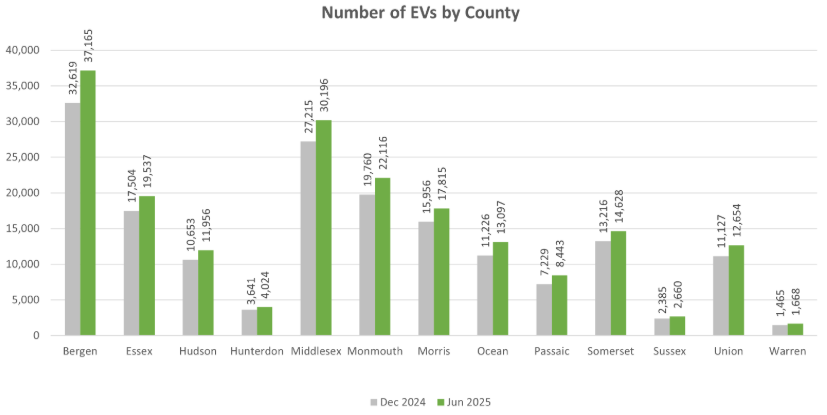
There were 21,963 new EVs registered in the NJTPA’s 13-county region between January and June 2025. That’s less growth than the previous six-month period of July-December 2024, when there were close to 29,700 new EVs; however, it’s similar to the approximately 22,000 reported for January-June 2024. Overall, there are 252,006 EVs on the road in New Jersey, including 195,909 in the NJTPA region. “Despite this great progress, it seems unlikely that New Jersey will meet its state goal of 333,00 EVs by the end of the year,” Tech-Czarny said.
The most recent update from the state Department of Environmental Protection data and available on the NJTPA’s EV Resources page.
Battery electric vehicles still comprise about 77 percent of EVs, and plug-in hybrid electric vehicles are about 22 percent. Neighborhood EVs, essentially golf carts, remain about 1 percent.
Nationally, EV sales jumped nearly 41 percent in the third quarter of this year from Q2 and nearly 30 percent year over year, hitting an all-time high, ahead of expiring federal tax credits, according to Cox Automotive. Meanwhile, The Wall Street Journal reported this week that other nations have followed the U.S. lead on rolling back EV sales mandates.
In Somerset and Bergen counties, EV registrations exceeded 5 percent of all vehicles registered, and Middlesex County is just shy of that.

Somerset County last month launched an EV Study through the NJTPA’s Subregional Studies Program, which aims to build on previous regional programs. Powering Ahead for Somerset County is a charging and suitability analysis with three main objectives:
- Develop county fleet transition plan
- Identify and analyze secondary EV charging corridors
- Identify public charging locations on County-owned sites.
Also part of this year’s Subregional Studies Program, Middlesex County is developing its Transportation and Mobility Plan, which will include some consideration of EVs. “We encourage subregions to do studies related to EVs and incorporate them into their plans,” Tech-Czarny said.
The NJTPA’s Subregional EV Charging Infrastructure Program can fund charging infrastructure on a subregion’s property for fleet and public use. The program has an open solicitation with a rolling submission. To apply, submit the intake application form.
More information can be found on NJTPA’s EV Resources page, including data about EVs in the NJTPA region, supporting EV adoption, and information about how to add EVs to a government or commercial fleet.
A recording of the RTAC meeting can be accessed here.