

The New Jersey Infrastructure Bank (I-Bank) offers another avenue for funding of projects related to transportation, infrastructure, and resilience.
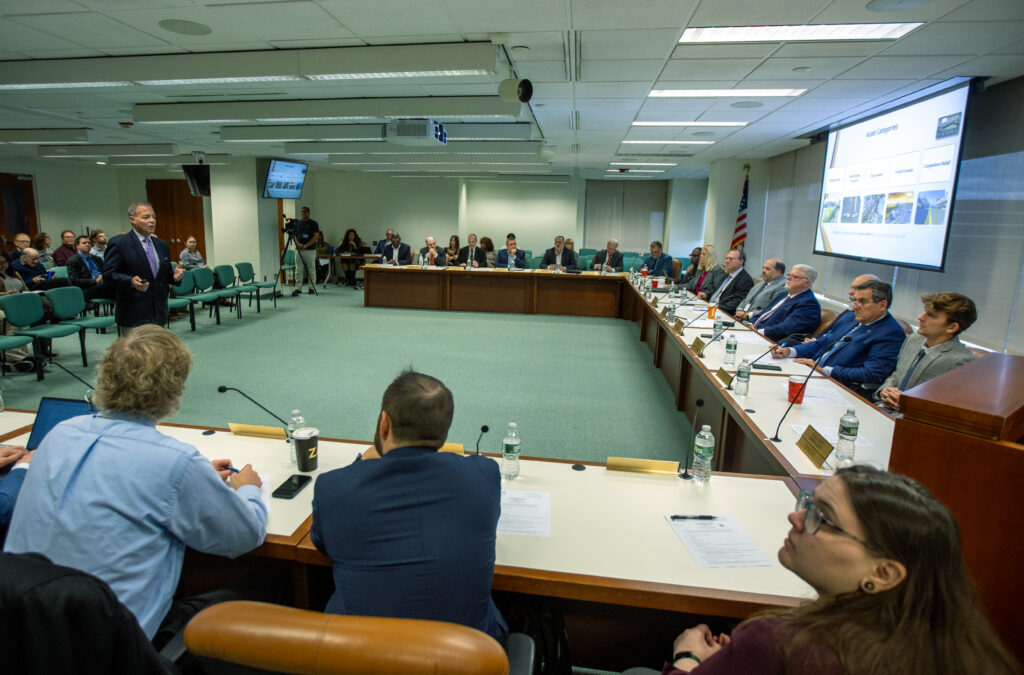
During the November 9 NJTPA Board of Trustees meeting, David E. Zimmer, executive director of the I-Bank, and Melinda Roslon, program manager for the Transportation Bank, outlined how low-cost financing can help counties and municipalities move infrastructure projects from planning and design through construction.
The presentation highlighted a natural connection to the NJTPA’s local planning assistance programs, which help municipalities identify strategies to improve safety, accessibility, and mobility. Once those plans are complete, communities still need to determine how to fund and implement the recommended improvements, and the I-Bank is one potential financing source to consider.
For example, the NJTPA’s Complete Streets Technical Assistance Program helps municipalities identify strategies to improve corridors for road users of all abilities. These can include traffic calming treatments, pedestrian improvements, bicycle facilities, and, more recently, green infrastructure.
From Planning to Implementation
The Transportation Bank works in partnership with the New Jersey Department of Transportation and is structured similarly to the agency’s Local Aid program, helping to minimize duplication for applicants. Projects can receive short-term financing for planning, design, and construction for up to five full fiscal years. The financing functions similarly to a line of credit, meaning borrowers only accrue interest on the amount they draw as project costs are incurred.
Once construction is complete, short-term financing can be converted to a long-term loan. For loans of 10 years or less, 75 percent of the financing is interest free, with the remaining 25 percent financed at the I-Bank’s AAA market rate. For loans longer than 10 years, 50 percent is interest free and 50 percent is financed at the I-Bank rate. Loans can extend up to 31 years, depending on the useful life of the project.
Roslon also highlighted a new incentive beginning in State Fiscal Year 2026: up to $100,000 in principal forgiveness for eligible planning and design costs per project, per fiscal year. The funding is offered on a first-come, first-served basis, and borrowers must ultimately convert to long-term financing to receive the principal forgiveness.
Making Projects More Affordable
The presenters illustrat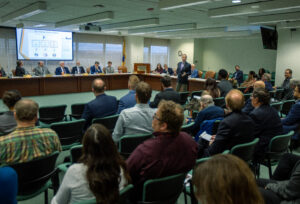 ed the potential savings using a hypothetical $5-million project. For a 10-year loan, I-Bank financing was estimated to save about 13 percent compared with independent financing. When paired with a 20-percent Local Aid grant, the estimated total project savings increased to about 35 percent. For a 20-year loan, examples presented showed potential savings ranging from about 19 to 44 percent, depending on the financing structure.
Zimmer encouraged municipalities to consider I-Bank financing even if they are already pursuing grant funding. Financing can potentially cover eligible costs that remain after a Local Aid grant or provide short-term funding that allows a project to begin while a municipality awaits grant funds. As Zimmer noted, a community waiting 12 to 18 months for a grant could potentially move construction forward sooner and repay the I-Bank loan when the grant funds become available.
Putting Funding to Work
Projects already financed through the I-Bank demonstrate how this type of funding can support many of the same improvements identified through Complete Streets planning.
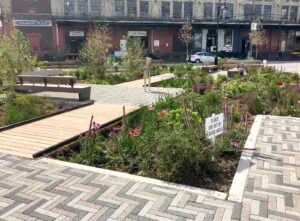
The City of Hoboken, for example, closed on a $3.4 million Transportation Bank loan to advance Vision Zero and resilience goals. The project includes a protected bicycle lane, high-visibility crosswalks, curb extensions, green infrastructure, green-gray tanks and bicycle parking. The improvements aim to enhance pedestrian and cyclist safety while increasing the city’s resilience to stormwater and climate impacts.
The City of Newark received a $450,000 Water Bank loan for a green infrastructure project. The project includes pervious pavers to capture and infiltrate stormwater runoff, pervious concrete for a gathering space and sidewalk, a stormwater planter and three curb cut inlets.
I-Bank financing is not limited to larger urban communities, and Complete Streets improvements can also be incorporated into broader roadway projects. In 2025, Hawthorne closed on a $6.6-million Transportation Bank loan for roadway improvements, including milling and resurfacing. The project calls for noncompliant curb ramps to be reconstructed to meet ADA standards, new sidewalks and driveway aprons that comply with Public Rights-of-Way Accessibility Guidelines, and bicycle-safe drainage improvements.
Zimmer’s advice to communities is straightforward: contact the I-Bank before assuming a project does not qualify. Depending on the project, there may be opportunities to combine grants, short-term financing, interest-free financing and other I-Bank programs to help move a project from planning toward implementation.
Watch a recording of the November 9 Board meeting on the NJTPA YouTube channel and access the presentation slides here.