

Townhouses with parking, along with new apartment buildings under construction, now occupy acres of former municipal brownfields and surface parking lots in Somerville. In Hoboken, construction of a new bus terminal and pedestrian plaza marks the first phase of a broader redevelopment that will include a renovated ferry terminal and an adjacent high-rise residential tower. At Metropark Station in Woodbridge, a mixed-use development features the new headquarters and medical offices of Hackensack Meridian Health.
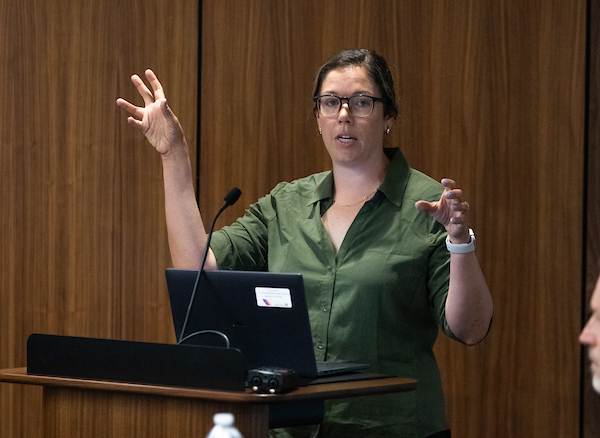
Together, these projects illustrate NJ TRANSIT’s recent push toward transit-oriented development (TOD), part of a long-term strategy to expand development around its stations and generate additional revenue beyond fares in the decades ahead. Megan Massey, director of Transit Friendly Planning at NJ TRANSIT, provided an overview of NJ TRANSIT’s LAND Plan during the NJTPA Board of Trustees July 13 meeting, held at Middlesex College in Edison.
The Transit Friendly Planning program has been around since the ‘90s, Massey said, and sets the stage around TOD around NJ TRANSIT stations and bus stops, both on publicly and privately owned land. “The concept of using TOD to generate non-fare box revenue is not new to NJ TRANSIT,” she said. “What is new is the broader acknowledgement of how we use our land has profound impacts on ridership, community vitality, access to housing, and economic opportunity. Bringing more destinations within easy reach of transit and more people use and value transit.”
 Said Massey: “TOD diversifies our revenue and captures value through our infrastructure and value capture from development around our facilities is just one of the many good reasons to pursue TOD.”
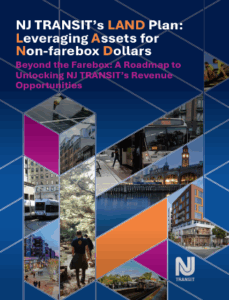
In October, NJ TRANSIT launched the LAND Plan, which stands for Leveraging Assets for Non-farebox Dollars. The agency previously established its TOD Policy Statement in 2024 and a Transit Friendly Planning Guide in 2022. The TOD Policy Statement guides the development of walkable, mixed use community around transit facilities, providing high-level guidance for local governments and developers around what NJT is looking for in terms of development on its properties, Massey said.
NJ TRANSIT analyzes real estate portfolio
The LAND Plan is the result of NJ TRANSIT analyzing its entire real estate portfolio. “It was a huge endeavor. We’re going through files we haven’t touched in 30 years, looking at copies of copies of old rights-of-way of railroads,” Massey said. “We dove into historic and inherited land records for opportunities to better leverage these assets for non-farebox revenue.”
Over 30 years, the LAND Plan estimated:
- Incremental revenue to NJ TRANSIT of $1.2 billion to $1.9 billion
- Economic impact to New Jersey of $10 billion to $14 billion
- Increase in municipal revenues of $1.1 billion to $1.6 billion
- New housing of 14,000 to 20,000 units, including 2,600 to 4,000 affordable units
- Between 30,000 and 50,000 New Jersey jobs created
- Solar power and wetland restoration
 “Obviously, this is all contingent on market conditions and close coordination with municipalities,” Massey said.
NJ TRANSIT’s first LAND Plan industry day in April showcased 11 sites planned to be offered to market this year and next, including five sites along the River Line, two along the Hudson-Bergen Light Rail, along with sites on the Northeast Corridor, Raritan Valley Line, and Atlantic City line. Also to be offered are Koppers Coke, an industrial site in Kearny and bus terminal on Bergenline Avenue in Union City.
Middlesex County Commissioner and NJTPA Chairman Charles Kenny said Woodbridge played a critical role in bringing partners together during the early planning stages of the Metropark project. Once redevelopment became a real possibility, coordination was essential because two of the roads serving the station are county-owned, making traffic signals and roadway improvements a key part of the discussion.
Kenny said community engagement was equally important. While the mayor initially had concerns about the project, ongoing collaboration among the township, NJ TRANSIT, the county and other partners led to a design that ultimately earned broad support. “It could be the kickstart to a whole redevelopment in that Metropark area for what we have there now,” he said.
“Communication, coordination early on, knowing that it’s an iterative process, knowing that nothing has been prescribed, is really important for everyone to know,” Massey said.
A recording of the July 13 Board of Trustees meeting is available on the NJTPA YouTube channel.