


It seems like we are finally entering into spring after a winter of freezing temperatures, strong winds, and snowfall. Were you thinking about how to weather whatever storm or extreme temperature day comes next? Are you interested in exploring how to create physical spaces to help community members who want the same? Check out the NJTPA’s recently launched guidebook, Resilience Hubs – A Community Roadmap.
 A resilience hub is a multi-functional place crucial to providing community support and offering services and resources before, during, and after extreme weather events.
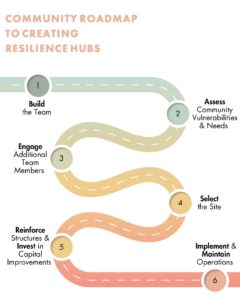
Resilience Hubs – A Community Roadmap provides municipalities with practical guidance on planning and implementing a resilience hub in their community. The guide includes an easy-to-follow roadmap to create a resilience hub in six steps, a toolkit with a collection of resources for providing emergency and ongoing services, potential funding opportunities, and case studies for inspiration.
Resilience Hubs – A Community Roadmap highlights existing resources in communities across North and Central New Jersey that communities can learn about for inspiration on what to add to their resilience hub:
- Informational Materials: The City of Hoboken (Hudson County) created a guide about residential flood risk reduction strategies in Resilient Building Design Guidelines Addendum (Addendum to the 2015 Guidelines).
- Tool Lending Libraries: Princeton Public Library (Mercer County) has an Emergency Preparedness section of their Library of Things that includes a carbon dioxide (CO2) monitor, emergency weather radio, mobile hotspot, mobile internet kit, and portable power station that residents can rent out.
- Community Classes: Montclair Ambulance Unit (Essex County) offers public classes on first aid, CPR/AED, Emergency Oxygen Administration and Stop the Bleed® (bleeding control for the injured).
Case studies highlight resilience hub efforts nationwide. For example, New Jersey communities can learn about strategies to get the public involved in creating a resilience hub from the Boyle Heights Arts Conservatory in Los Angeles. The partnership held asset mapping workshops with the community to identify existing neighborhood resources that the resilience hub could connect with and build off while creating the resilience hub.
Resilience hubs can provide a host of ongoing economic, social, and ecological benefits to the community:
- During extreme weather events, resilience hubs can provide shelter, blankets for cold weather, water bottles for hydration during heat waves, and chargers to keep electronic communication devices powered. With distributed power, resilience hubs can provide reliable electricity and HVAC when the rest of the power grid may be down.
- Outside of extreme weather events, resilience hubs can provide information on extreme weather preparedness and recovery. They can directly reduce the risk of flood damage and extreme heat impacts on site through stormwater management infrastructure and green space. Additionally, resilience hubs can be leveraged to develop and enhance social services and programs, while also building connections and operational capacity to improve the overall welfare of communities year-round.
Building a resilience hub is not creating a new building from scratch; rather, it’s about enhancing an existing facility with additional resources related to extreme weather, and hardening the facility against storm events. Potential candidate facilities can include schools, community centers, or libraries.
With efficient management and maintenance, resilience hubs may reduce the burden on local response teams, increase efficacy of community-based organizations and faith-based groups, and serve as a centralized resource to bring partners together.
To learn more and download the Resilience Hubs – A Community Roadmap, visit https://njtpa.org/studies/resiliencehubs-acommunityroadmap/