


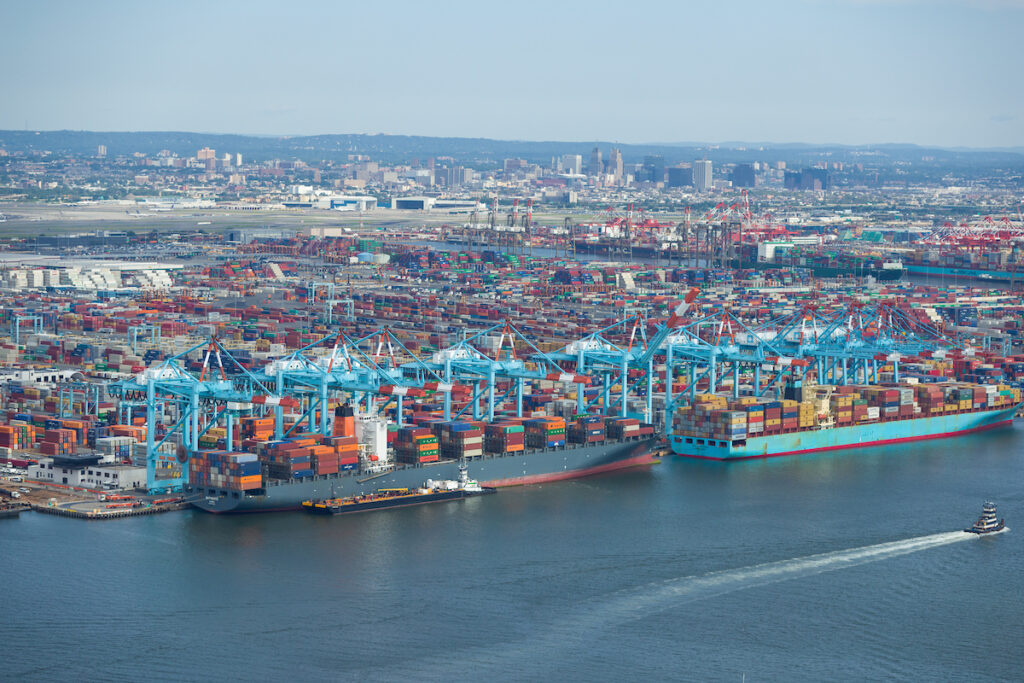
Seasonality seems to be a thing of the past when it comes to container volumes at the Port of New York & New Jersey, where growth continues even after leveling off since a historic spike during the pandemic.
Beth Rooney, Director, Port Department at the Port Authority of NY and NJ, and John Nardi, president of the Shipping Association of New York and New Jersey, presented the Annual Port Update during the NJTPA’s Freight Initiatives Committee meeting on April 20.
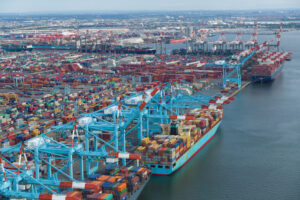
The Port last year handled 8.9 million Twenty-Foot Equivalent Units (TEU), up 2.3 percent over 2025 and 4.3 percent over its forecast. TEU is the standard marine shipping container, which can hold up to 28 metric tons.
New York & New Jersey is predominantly a truck port with 85 percent of its volume remaining within about 250 miles of port facilities, Rooney said, compared with 719,000 rail lifts, or about 8 percent of TEUs.
Automobiles through the Port dropped by about 12 percent from the previous year, to 365,000, a decline Rooney attributed to tariff-related impacts. Some 3.1 million metric tons of bulk cargo were handled, which includes materials, such as cement, road salt, edible oils, orange juice concentrate. About 846,000 cruise passengers departed from Bayonne but close to 2.5 million passengers in all took cruises out of the Port of New York and New Jersey, including terminals in Manhattan and Brooklyn.
The Port projects between 12 million and 17 million TEUs through the port by 2050. The lower end of that range is based on focusing on the local market, Rooney said, while the higher end includes the discretionary market that could go to ports elsewhere, such as, California and Virgina, to reach the middle of the country.
Nardi shared that seasonality has all but disappeared since the pandemic which makes it difficult to predict where and when to move labor.
Raising the Bayonne Bridge and deepening the channels to 50 feet allowed the Port to handle ships with more than 9,000 TEUs. About one-third of the ships coming into the Port today were unable to use the channels prior to those projects, according to Rooney. The Port recently welcomed its largest ship yet, able to handle almost 17,000 TEUs.
Even before the channel deepening project was completed, Rooney said they realized they needed to go to 55 feet. Working with the Army Corps of Engineers, the Port will work to deepen 28 miles of federal channels to 55 feet and selective widening in certain locations.
Contracts and Labor
In April, the Port entered a 30-year extension with APM terminals, following a similar 33-year extension with Maher Terminals in December. That now leaves the Port’s five major terminals with leases that run through between 2047 and 2063.
The latest longshoremen’s contract was finalized in March 2025, following a three-day strike in October 2024, which ended with an agreement on wages and allowed for several more months to conclude negotiations.
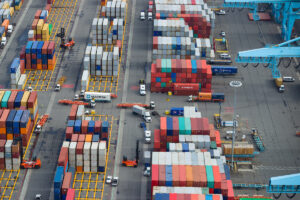
Automation was the most controversial aspect of negotiations, Nardi said, and likely to continue to be going forward for the industry but even more so for the Port. “Labor sees automation as an existential issue, not just for our industry but for many,” Nardi said. “This will be a point of contention in future contracts.” Technology and automation provide for more cargo density, which is a challenge since land is limited. “We have to make better use of how we handle that same footprint,” he said.
“This business is the fuel that primes the pump of the economic engine in the region,” Nardi said. As of 2024, the Port accounted for 580,000 total jobs, including 277,000 directly associated with the Port. That’s in addition to an estimated $163 billion in business activity, $57 billion in personal income, and more than $18 billion in federal, local, and state tax revenues.
The Port has been responsible for growing jobs for years according to Nardi, from 296,000 in 2012 to 400,000 in 2016, and 506,000 in 2019, and a peak of 560,000 at the height of COVID when volume was off the charts. “This business continues to grow with the volume of the Port,” Nardi said, and “needs to continue to evolve to maintain our preeminent position on the East Coast.”
A recording of the FIC meeting is available on the NJTPA YouTube channel.