


The meteoric rise of e-commerce has created a battle for curb space in many cities, leading to an array of strategies to address the abundance of deliveries.
A panel of researchers offered a glimpse of various urban delivery strategies employed across North America during the NJTPA’s Freight Initiatives Committee meeting on Aug. 17.
The last 50 feet
Most of a delivery driver’s time is spent in the final 50 feet, searching for a suitable parking location, idling, walking to a customer location, and handling goods, according to Dr. Giacomo Dalla Chiara.

“The last 50 feet is an important part of a delivery process but we don’t know much about it. And we don’t account for it when we do routing of delivery vehicles in urban areas,” he said. “This is very important because there is a lot of behavior that comes with the last 50 feet and the infrastructure that we allow delivery drivers to use.” He explained that vehicles cruising for parking and then the physical delivery by foot is a part of delivery that there is little data available.
Dalla Chiara is a senior research scientist at the Urban Freight Lab at the University of Washington in Seattle. He presented a comparative analysis of commercial vehicle load zone programs across U.S. cities, based on a paper he co-authored.
Researchers analyzed the infrastructure, policy, and regulation of existing commercial zones of 13 cities, varying from 0.1 to 10 percent of curb space allocated for commercial vehicles.
Some cities distinguish between commercial and truck loading zones while others have specialty loading zones, such as Seattle’s entertainment loading zones, and some have hotel loading zones. Portland, Oregon has a green loading zone for low-emission vehicles. In Miami Beach, commercial use is allowed in alleys if it doesn’t coincide with waste management activities.
“It’s a set of strategies. It’s not just about allocating curb parking to commercial vehicles,” Dalla Chiara said. “It’s defining and deciding also where that parking area is, what is the definition of free vehicles, who are authorized users of curb zones, and do we want to price them?”
E-cargo tricycles and microhubs for urban delivery
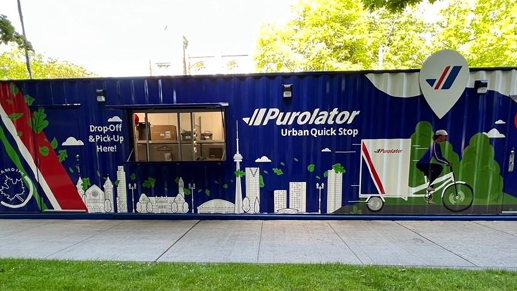
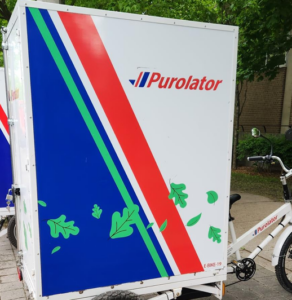
 In Toronto, a pilot program replaced traditional light duty box trucks with electric cargo tricycles for urban delivery. Operating from a microhub to serve the University of Toronto campus and three adjacent neighborhoods, three e-cargo tricycles replaced three truck routes. A remodeled shipping container occupying five curbside parking spaces was used as a retail pickup/dropoff point, shipment storage space, and overnight tricycle charging.
Dr. Farah Ghizzawi, a doctoral researcher at the University of Toronto, assessed the pilot and how the neighborhood microhub concept could be expanded citywide and used as a template beyond Toronto.
The most telling number in the analysis was the tricycles’ dwell time of 7.2 minutes per stop compared to 17.8 minutes for trucks, Ghizzawi said. What could have been one stop with a truck was two or three for a tricycle, but the trikes were able to park closer to customers and do more courier stops. The “quantifiable payoff,” she said, was emissions, with a projected 3 tons of GHG eliminated annually for each route replaced. (A single truck emits 10.5 to 13 kg of GHG per day).
 A model designed to estimate what city scale operations should be suggests a network of 79 microhubs, with 11 downtown and 68 in the inner urban area, requiring a total of 237 tricycles. The average service area for each downtown microhub would be about a quarter-mile while in the urban inner area hub would serve an area of about three-quarters of a mile.
Demand density – not tricycle range – is the key factor in microhub viability, according to Ghizzawi. Capacity limits matter more where demand is dense and cost matters more where it’s less dense. Thus, downtown is an area that should be targeted first because the payoff for microhubs would be faster, she said.
Ghizzawi presented an interactive planning tool that estimates the number of microhubs and fleet required to serve a study area, along with optimal locations, based on various factors.
E-commerce delivery mitigation study
An e-commerce delivery mitigation study under way by the NJTPA will identify strategies for addressing specific challenges and problems and develop plan to deploy optimal e-commerce mitigation strategies to improve urban delivery.
“There is no one-size-fits-all solution for any city logistics strategy but especially when it comes to e-commerce,” said Dr. Alison Conway, a professor at the City College of New York. The study will examine what infrastructure is required, types of vehicles and business models.
“Our study is going to look at all these different strategies and try to find a good fit,” said Dr. Branislav Dimitrijevic, a professor at NJIT, who is leading the study with Conway. Many of these strategies work but they don’t always work or not in every location. The context of location, urban deliveries, demand, land use, infrastructure, available curb space, are all going to dictate what kind of strategies would be appropriate and feasible, he said. “Most important: Which would be most effective for a given location.”
A recording of the presentations can be accessed on the NJTPA YouTube channel.