


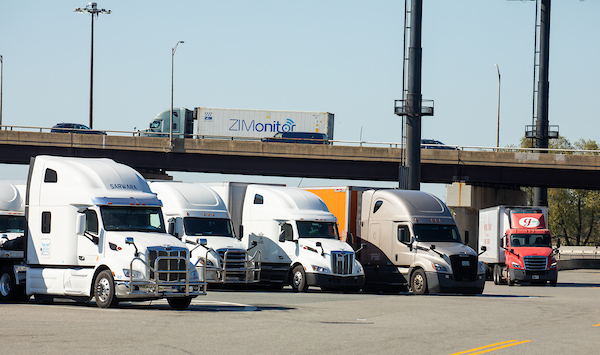
State transportation officials and consultants detailed the state of the freight economy and activities across all relevant modes, including rail, maritime, and air cargo, as part of the Statewide Freight Plan Update during a presentation to the NJTPA’s Freight Initiatives Committee (FIC) meeting on June 15.
The initial focus of the freight program was to meet federal requirements but the program has grown organically to build awareness of freight needs, said Janice Marino-Doyle, Program Lead for the Office of Freight Planning (OFP) in the New Jersey Department of Transportation (NJDOT). Following completion of the 2017 Statewide Freight Plan, the OFP expanded the planning program.
Stephen Chiaramonte, Vice President, Transportation Planning at consulting firm WSP, described the Statewide Freight Plan as “the blueprint for the state to prioritize infrastructure improvements as well as policy initiatives.
“It’s a recognition of the need to understand how, where, and what goods move on our state’s multimodal freight network.”
Federal mandates require states to complete a freight plan every four years, which is tied to National Highway Freight Program (NHFP) funding. For New Jersey, that’s about $38 million in 2026 and $400 million over next 10 years, according to Chiaramonte.
Statewide Freight Plan 2027 Goals
The goals of the 2027 Statewide Freight Plan are:
- Safety, security and system reliance
- Infrastructure condition and state of good repair
- Freight mobility, reliability and operational efficiency
- Multimodal connectivity accessibility
- Technology, data and innovation
- Environmental stewardship, sustainability and community impacts
- Economic competitiveness and freight system productivity
- Collaboration, governance, funding and program delivery
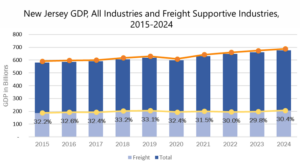 Historically, freight is an important sector to New Jersey. It has experienced steady growth, according to Stephanie Finch of WSP, and accounts for $200 billion of the state’s GDP—about 30 percent—and almost one of every three jobs, despite some softening since highs experienced during the pandemic.
Container growth at the Port Authority of New York and New Jersey continues, with 8.9 million TEUs processed in 2025 and industrial inventory within Northern and Central New Jersey has reached 875 million square feet.
The plan provides an analysis of highways and the cost of congestion as a result of bottlenecks.
Overall truck safety has improved, with fatal crashes declining significantly after 2022 and remaining relatively flat since. However, that progress has been offset by a concerning increase in interstate fatalities, which have nearly doubled. “Clearly, it’s something that needs to be considered as we move our plan forward,” Chiaramonte said.
Only about 7 percent of truck crashes occur between midnight and 5 a.m. yet that time frame accounts for almost 30 percent of fatal crashes. It underscores truck parking as one of the most significant needs in the state, Chiaramonte said, as parking in undesignated areas often creates crash incidents.
The new freight plan uses telematics data to show where trucks frequently engage in harsh driving events, like braking, acceleration, and cornering. Originally developed for fleet managers to understand driver patterns, the data now are used “to understand locations where near misses may result in future crash clusters,” Chiaramonte said.
He summarized some of the initial insights from the top 10 harsh events in the data. As an example, he noted Stiles Street in Linden, approaching the Northeast Corridor overpass, as being ranked No. 1 in the state for harsh breaking and No. 9 for harsh acceleration. The location was studied in 2020 for the Union County Truck Mobility Study, part of the NJTPA’s Subregional Studies Program.
There is a clearance sign near the location but it’s off to the side and a bit obscured, Chiaramonte said, and as truckers turn from Linden Avenue, they’re unaware of the impending potential clearance issue, leading them to break sharply before determining if they can pass under the rail bridge.
“It highlights a very clear issue that could potentially be addressed through smaller investments,” he said, like signage and striping that can substantially reduce the potential for crashes. “There will be more to come out of this analysis where we’ll be able to prioritize locations for further study as actions from the plan.”
In addition to soliciting input from forums like the FIC, a public survey is coming later this summer to understand current perspectives and perceptions of freight in New Jersey, Chiaramonte said.
A recording of the FIC meeting is available on the NJTPA YouTube channel.