


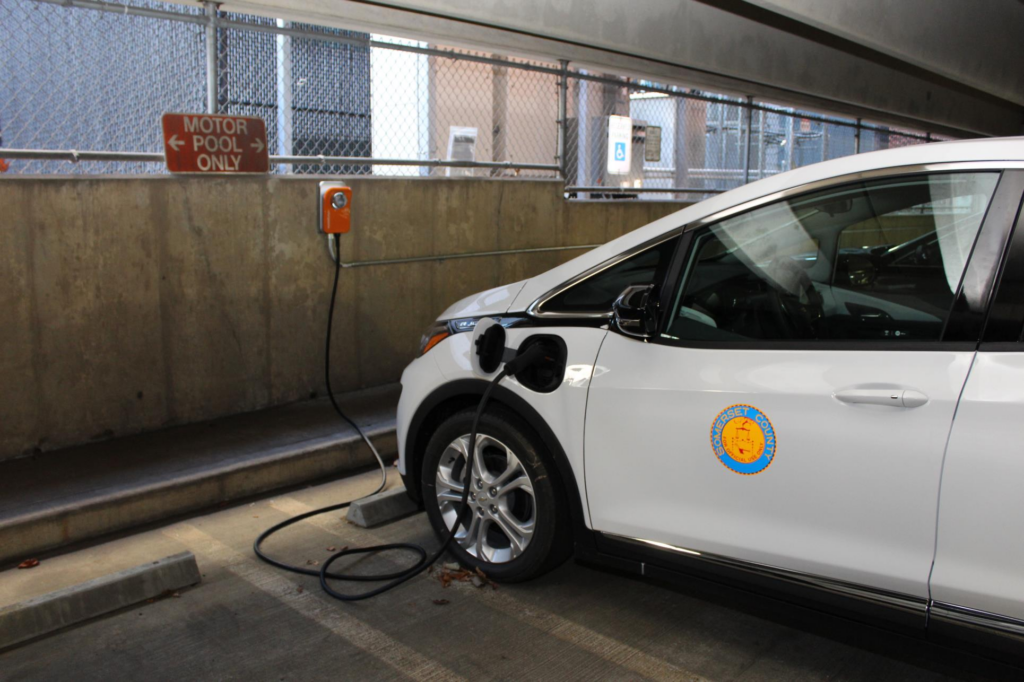
A study of gaps and opportunities identified three priority locations for public electric vehicle (EV) infrastructure within Somerset County and established a road map for transitioning the county fleet to electric vehicles.
“Powering Ahead for Somerset County: The Somerset County Electric Vehicle Study” was completed and funded through the NJTPA’s Subregional Studies Program (SSP). Samantha DeAndrea, Director, and Ken Wedeen, Supervising Transportation Planner, Somerset County Division of Planning, presented the study at the June meeting of the NJTPA’s Joint Project Prioritization and Planning and Economic Development Committees.
The 70-page report guided three primary efforts, including transitioning the County fleet to zero emission vehicles (ZEV), designating secondary EV charging corridors that complement federally designated Alternative Fuel Corridors (AFC), and prioritizing county-owned properties for publicly accessible EV infrastructure.
The study noted three key findings:
- Charging coverage is uneven by charger type: Level 2 charging is more prevalent in central areas of the County while northern and southern areas are comparatively sparse, especially for Level 3 chargers.
- Secondary corridors can help close network gaps. Either non-interstate corridors were identified to extend coverage beyond I-78 and I-287 and better connect population, employment, and activity centers.
- Near-term County fleet electrification is most feasible for light-duty vehicles, based on market availability and operational fit.
Primary corridors are focused on interstates, federally designated as AFCs. Secondary corridors are intended to complement that network and help to connect to local destinations, such as parks and downtowns areas.
“Demand is only one part of the equation. Site feasibility is the other,” DeAndrea said. Flood risk, lot configuration, and other factors can all affect cost and timing of installation, she added.
The study evaluated 43 county-owned properties for charging locations. That list was narrowed to 14 candidate locations, and ultimately three priority locations were selected:
- Lord Stirling Park and Environmental Center, Basking Ridge, six Level 2 chargers, five dual port, one single port for ADA compatibility, at an estimated capital cost of $300,000;
- Colonial Park & Howe Athletic Complex, Somerset, eight Level 2 chargers, seven dual port, one single port for ADA compatibility, $400,000; and,
- Mountain View Park Baseball Field, Hillsborough, 14 Level 2 chargers, 13 dual port, one single for ADA compatibility, $700,000.
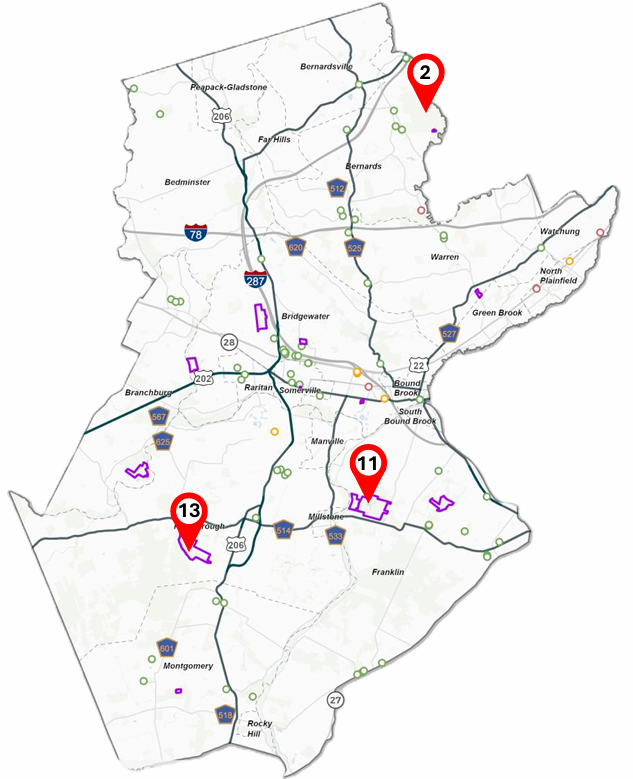 Lord Stirling Park (No. 2 in the map on the right) fills a coverage gap in northern Somerset County. Colonial Park (No. 11) projects potential for high year-round usage. It’s also close to Amwell Road (County Road 514), a secondary corridor. Mountain View Park Baseball Field (No. 13) is linked to Route 206, a proposed secondary corridor, and has abundant parking along with a large walking trail and playground. Future expansion of multi-use athletic fields should mean usage is bound to increase.
The plan would begin with phased installations, Wedeen said, and then monitoring the use before expanding toward projected 2035 demand.
The study breaks out implementation into three phases:
- Near term (within a year): Finalize priorities, electrical capacity checks, utility coordination, funding strategy, and fleet pilot planning.
- Mid-term (within three to five years): Design and permitting, procurement and construction, operators/pricing policies, pilot deployments, and workforce training.
- Long term (more than five years): Monitor utilization, scale public sites, update fleet inventory, reassess heavy-duty technology, and refine policies.
Somerset County Fleet Transition
The study grouped Somerset County’s fleet of 872 vehicles across 39 departments into six tiers.
Tier 1 includes sedans, SUVs, minivans, and other light-duty vehicles, which are the most suitable candidates for early electrification due to their widespread use and the availability of zero-emission vehicle (ZEV) models.
Tier 2a includes buses, cargo vans, full-size pickup trucks, and police vehicles. Tier 2b consists of vehicle types for which ZEV models are not yet widely available, such as small- and mid-size pickup trucks and shuttle buses. These vehicles may become viable candidates for near-term electrification as additional models enter the market, although they require greater operational consideration.
Tiers 3 through 6 include heavy-duty vocational trucks and specialized equipment that face greater market and technical constraints. As a result, these vehicle types are not currently recommended for electrification but may be suitable for mid- to long-term adoption as vehicle technology and supporting infrastructure continue to mature.
- Considerations in the fleet transition include:
- Align EV purchases with replacement schedules and duty cycles
- Pick first fleet pilot locations based on vehicle mix and facility readiness not just vehicle age
- Use shared facilities and larger fleet concentrations to maximize charger utilization
- Confirm electrical capacity early, transformer and switchgear lead times can drive schedule
- Train operators, maintenance staff, and supervisors before scaling beyond pilots.
The complete study is available in the NJTPA Studies database: Somerset County Electric Vehicle Charging and Suitability Analysis – NJTPA.